Myth vs. Reality: You Can’t File Bankruptcy If You Own a House

Published

One of the most common misconceptions I hear from people considering bankruptcy is that they cannot file bankruptcy because they own a house. Some people believe that filing Chapter 7 bankruptcy automatically means the bankruptcy trustee will take their home and sell it to pay their creditors.
The truth is that owning a house does not prevent you from filing bankruptcy. I file bankruptcy cases every day for clients who own homes, and over my 35-year career, I have helped thousands of homeowners use bankruptcy to address their financial problems while protecting their homes.
Having represented more than 25,000 people in bankruptcy, I can tell you that the question is not simply whether you own a house. The important questions are how much equity you have in the property, which bankruptcy exemptions are available to protect that equity, and which type of bankruptcy best fits your financial circumstances.
Let’s separate the myth from the reality.
Table of Contents
- Myth: If You Own a House, You Cannot File Chapter 7 Bankruptcy
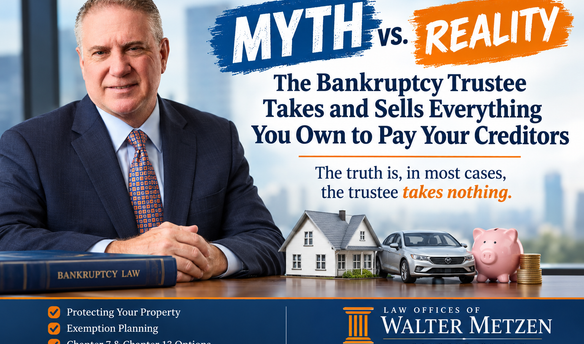
- Myth: The Bankruptcy Trustee Will Take My House to Pay My Creditors
- Myth: If I Am Behind on My Mortgage, Bankruptcy Cannot Help Me Save My House
- Myth: If My House Is Worth Less Than I Owe, I Still Cannot File Bankruptcy
- Myth: If I File Bankruptcy, I Must Give Up My House
- My Experience Representing Homeowners in Bankruptcy
- Conclusion: Owning a House Does Not Mean You Cannot File Bankruptcy
Myth: If You Own a House, You Cannot File Chapter 7 Bankruptcy
Reality: You Can File Chapter 7 Bankruptcy While Owning a House
There is no rule under federal bankruptcy law that prohibits you from filing Chapter 7 bankruptcy simply because you own a house.
I regularly file Chapter 7 cases for clients who own their homes. The same is true for people who own condominiums, manufactured homes, vacation properties, and other types of real estate.
The critical issue in a Chapter 7 bankruptcy is whether the property has nonexempt equity that a bankruptcy trustee could potentially administer for the benefit of creditors.
Equity is the difference between the value of your house and the amount you owe against it.
For example, suppose your home is worth $300,000 and you owe $250,000 on your mortgage. You have approximately $50,000 in equity before considering selling expenses or other relevant factors.
That does not automatically mean you will lose your home in bankruptcy. The next step is determining how much of that equity can be protected under the applicable bankruptcy exemptions.
Myth: The Bankruptcy Trustee Will Take My House to Pay My Creditors
Reality: Bankruptcy Exemptions Can Protect Your Home Equity
When I evaluate a Chapter 7 bankruptcy case involving a homeowner, one of the first things I examine is the amount of equity in the property and the exemptions available to protect it.
Bankruptcy exemptions are laws that allow debtors to protect certain property from creditors and, in bankruptcy, from a trustee’s efforts to administer nonexempt assets.
Depending on the circumstances, a Michigan debtor may be able to use applicable federal bankruptcy exemptions or Michigan state exemptions. The proper choice depends on the debtor’s eligibility, applicable domicile requirements, the amount and nature of the equity, and the other assets that need protection.
The homestead exemption is particularly important when a client owns a house.
For example, if a homeowner has $40,000 in equity and the applicable homestead exemption fully protects that equity, there ordinarily would be no nonexempt home equity for the trustee to distribute to creditors. Other considerations, including liens and the trustee’s potential costs of sale, also matter.
On the other hand, if a homeowner has substantial equity that exceeds the available exemptions, the analysis becomes more complicated. A trustee may have the ability to sell a property in certain circumstances, subject to applicable law, liens, exemptions, and other requirements.
That is why it is so important to have an experienced bankruptcy attorney carefully evaluate your situation before filing.
The goal is to determine whether your home equity can be protected before your bankruptcy case is filed.
Over my career, I have filed more than 25,000 bankruptcy cases and represented thousands of people who owned homes. To date, no client of mine has lost a house to a bankruptcy trustee as a result of the cases I have handled, with careful exemption planning being an important part of that experience.
Every case is different, and no attorney can responsibly guarantee that every home is protected regardless of its equity or the circumstances. But you should never assume that you cannot file bankruptcy simply because you own a house.
Myth: If I Am Behind on My Mortgage, Bankruptcy Cannot Help Me Save My House
Reality: Chapter 13 Bankruptcy Can Help Homeowners Catch Up on Missed Mortgage Payments
Chapter 7 is not the only bankruptcy option available to homeowners. In fact, many of the bankruptcy cases I file are Chapter 13 cases designed to help clients save their homes from foreclosure.
If you have fallen behind on your mortgage payments because of a job loss, illness, divorce, reduced income, or another financial setback, the arrearage can become overwhelming. Interest, late charges, and foreclosure expenses may make it even more difficult to catch up.
Chapter 13 bankruptcy can provide a way to address this problem.
In a typical Chapter 13 case, a homeowner may propose a repayment plan that allows the debtor to catch up on qualifying past-due mortgage payments over time while generally resuming regular ongoing mortgage payments, subject to the requirements of the Bankruptcy Code and the court’s approval. The automatic stay generally stops foreclosure activity when the case is filed, although exceptions and other limitations apply.
For example, suppose you are $18,000 behind on your mortgage. You may be able to propose a Chapter 13 plan to repay that arrearage over a period of three to five years, subject to the requirements of the Bankruptcy Code and the court’s approval.
This can give you an opportunity to save your home rather than lose it through foreclosure.
Chapter 13 is not a solution for every homeowner. You generally must have sufficient income to make your ongoing mortgage payments and fund a feasible repayment plan. The timing of a bankruptcy filing, prior bankruptcy cases, the status of foreclosure proceedings, and the terms of the mortgage can also affect the available options.
Nevertheless, if you are behind on your mortgage and want to keep your home, you should explore whether Chapter 13 bankruptcy can help before assuming that foreclosure is inevitable.
Myth: If My House Is Worth Less Than I Owe, I Still Cannot File Bankruptcy
Reality: An Upside-Down House May Be a Reason to Consider Bankruptcy
Some homeowners discover that their houses are worth less than the amount they owe on their mortgages. This situation is commonly called being “upside down” on a house, or having negative equity.
For example, suppose you purchased a house for $350,000 and still owe $340,000 on your mortgage. If the house is now worth only $300,000, you are upside down by approximately $40,000 before accounting for selling expenses.
In other words, even if you sold the house for its current market value, the sale proceeds would not be sufficient to pay off the mortgage in full.
This can be a particularly difficult situation for homeowners who are also struggling with credit card debt, medical bills, personal loans, or other unsecured obligations.
In some circumstances, a homeowner may decide that keeping the property no longer makes financial sense. The mortgage payment, property taxes, insurance, maintenance, and other expenses may be difficult to justify when the house is worth less than the outstanding mortgage balance.
A Chapter 7 bankruptcy may allow the homeowner to surrender the property and obtain a discharge of qualifying personal liability for the mortgage debt, including a potential deficiency balance, subject to the Bankruptcy Code and any applicable exceptions.
A deficiency is the amount remaining unpaid after collateral is sold or otherwise disposed of and the proceeds are applied to the secured debt. Whether a deficiency exists and how much it amounts to depends on the facts, the loan documents, applicable law, and the disposition of the property.
For example, suppose you owe $340,000 on your mortgage, but the house ultimately sells for $300,000. After applying the sale proceeds and accounting for applicable expenses, there may be a substantial deficiency.
If you qualify for Chapter 7 and receive a discharge, your personal liability for a dischargeable deficiency may be eliminated. The bankruptcy discharge does not, by itself, eliminate the mortgage lien or require the lender to release its lien without addressing the property. The lender may still enforce its rights against the collateral, subject to applicable law.
This distinction is important: bankruptcy may eliminate your personal obligation to pay a dischargeable mortgage deficiency even though the mortgage lien itself is not automatically erased.
For some homeowners, surrendering an upside-down house through bankruptcy can provide a fresh financial start and allow them to move forward without being burdened by a large mortgage deficiency and other dischargeable debts.
Myth: If I File Bankruptcy, I Must Give Up My House
Reality: The Right Bankruptcy Strategy Depends on Your Goals
Not every homeowner who files bankruptcy wants to surrender a house. Many want to keep it, while others have reached the point where surrendering the property is the most sensible financial decision.
That is why I do not approach every homeowner’s bankruptcy case the same way.
When I meet with a homeowner, I evaluate the circumstances, including:
- The current fair market value of the house.
- The outstanding mortgage balance and any additional liens.
- The amount of equity, if any, in the property.
- The applicable federal or Michigan bankruptcy exemptions.
- Whether the homeowner is current on mortgage payments or facing foreclosure.
- Whether the homeowner can afford to keep the property.
- Whether Chapter 7 or Chapter 13 is the more appropriate option.
- Whether surrendering the property would address a broader financial problem.
If your equity can be fully protected, Chapter 7 may be a viable option even if you own a house. If you are behind on mortgage payments and want to save the property, Chapter 13 may provide a way to catch up on arrearages. If you are upside down on the property and cannot afford to keep it, Chapter 7 may offer a way to surrender the house and discharge qualifying personal liability for the mortgage debt.
The right answer depends on the facts of your case.
My Experience Representing Homeowners in Bankruptcy
I have spent more than 35 years practicing bankruptcy law and have represented over 25,000 people in bankruptcy cases. My practice focuses exclusively on bankruptcy, and I am a Board-Certified Specialist in Consumer Bankruptcy.
Throughout my career, I have helped thousands of homeowners navigate bankruptcy while evaluating how to protect their homes, address mortgage arrearages, or surrender properties that no longer make financial sense.
I understand that your house is often your family’s most important asset. I also understand that the fear of losing it can prevent people from getting the financial relief they need.
That is why careful analysis and exemption planning are so important.
You should not assume that filing bankruptcy means losing your house. You should not assume that having equity automatically disqualifies you from Chapter 7. And if you are behind on your mortgage, you should not assume that foreclosure is your only option.
Conclusion: Owning a House Does Not Mean You Cannot File Bankruptcy
The myth that you cannot file bankruptcy if you own a house is simply not true.
Homeowners file Chapter 7 bankruptcy every day. Applicable bankruptcy exemptions may protect their home equity, while Chapter 13 can help eligible homeowners catch up on mortgage arrearages and work toward preventing foreclosure. For homeowners who are upside down on their properties, Chapter 7 may also provide a way to surrender the house and discharge qualifying personal liability for a mortgage deficiency.
The key is understanding your financial situation, the applicable exemptions, and the bankruptcy options available to you before making a decision.
If you own a house and are struggling with credit card debt, medical bills, mortgage arrearages, or other financial problems, do not let this common myth prevent you from exploring your options.
I am Walter Metzen, Board-Certified Specialist in Consumer Bankruptcy. I have represented more than 25,000 people during my career, and I can help you understand whether Chapter 7 or Chapter 13 bankruptcy may be appropriate for your circumstances.
Contact my office to discuss your situation and learn what options may be available to protect your home and obtain a fresh financial start.
This article is for general informational purposes and is not legal advice. Bankruptcy exemptions, mortgage liens, foreclosure rights, and dischargeability depend on the facts of each case and applicable law.