Myth vs. Reality: Will Filing Bankruptcy Ruin My Spouse’s Credit?

Published
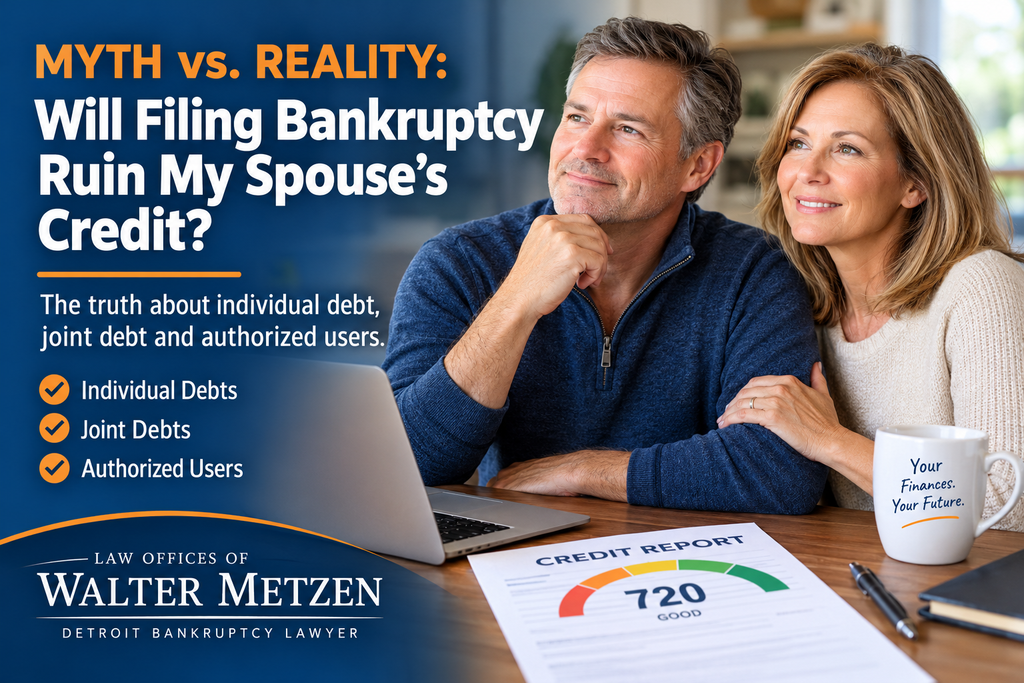
One of the most common concerns I hear from married couples considering bankruptcy is this: “If I file bankruptcy, will it ruin my spouse’s credit, too?”
It is an understandable concern. Many people worry that if one spouse files Chapter 7 or Chapter 13 bankruptcy, the other spouse will automatically suffer the same consequences, even if they have good credit and have never had financial problems of their own.
The good news is that this is one of the biggest myths about bankruptcy. In most situations, one spouse can file bankruptcy without damaging the other spouse’s credit.
I have represented thousands of individuals in both Chapter 7 and Chapter 13 bankruptcy cases where only one spouse filed. In my experience, filing bankruptcy for one spouse does not, by itself, ruin the other spouse’s credit.
After more than 35 years practicing bankruptcy law, I have seen how much unnecessary anxiety this misconception causes. Let’s look at the facts.
Table of Contents
- Myth: When You Get Married, You Assume Your Spouse’s Debts
- Reality: One Spouse Can File Bankruptcy Without Ruining the Other Spouse’s Credit
- Individual Debts vs. Joint Debts: Understanding the Difference
- 3. Authorized Users: An Important Credit Card Distinction
- What About the Family Home and Car Loans?
- Should Both Spouses File Bankruptcy Together?
- My Advice After Thousands of Bankruptcy Cases
- Frequently Asked Questions
- Let’s Discuss Your Options
Myth: When You Get Married, You Assume Your Spouse’s Debts
This is simply not true.
Getting married does not automatically make you legally responsible for all of your spouse’s credit cards, personal loans, medical bills, or other debts. If your spouse accumulated $50,000 in credit card debt before or during the marriage, that does not automatically mean you owe that $50,000, too.
In Michigan, as in most states, marriage alone does not make one spouse responsible for the other spouse’s individual debts.
There are exceptions and special circumstances, including situations involving jointly signed loans, certain obligations incurred on behalf of a spouse, and particular state-law rules. But the general rule is straightforward: you do not automatically become responsible for your spouse’s debts just because you got married.
The same principle generally applies when one spouse files bankruptcy. Bankruptcy is an individual legal proceeding, and one spouse’s filing does not automatically put the other spouse into bankruptcy.
Reality: One Spouse Can File Bankruptcy Without Ruining the Other Spouse’s Credit
I have filed thousands of Chapter 7 and Chapter 13 bankruptcy cases for individuals whose spouses did not file bankruptcy.
In these cases, the non-filing spouse does not automatically receive a bankruptcy notation on their credit report simply because their husband or wife filed.
For example, suppose a married couple owns a home, has two vehicles, and maintains several credit card accounts. The husband has accumulated substantial credit card debt in his own name, and he can no longer afford the payments. His wife has maintained good credit and wants to protect it.
Depending on their financial circumstances, the husband may be able to file Chapter 7 bankruptcy or Chapter 13 bankruptcy individually while his wife does not file.
His bankruptcy filing does not automatically become hers. Her individual credit accounts do not automatically become part of his bankruptcy, and her credit score does not automatically drop because he filed.
Of course, the details matter. Joint accounts, authorized-user arrangements, and other financial relationships can affect the outcome. But there is no general rule that both spouses must file bankruptcy together or that one spouse’s bankruptcy necessarily destroys the other spouse’s credit.
Individual Debts vs. Joint Debts: Understanding the Difference
One of the most important things to understand when considering bankruptcy as a married couple is the difference between individual debt and joint debt.
1. Individual Debt
Individual debt is debt for which only one spouse is legally responsible.
Examples may include:
- Credit cards opened in one spouse’s name alone.
- Personal loans signed by only one spouse.
- Medical bills owed by one spouse.
- Other loans or obligations for which the non-filing spouse has no legal responsibility.
If the husband files bankruptcy on credit cards that are solely his responsibility, his wife generally does not become responsible for those debts merely because they are married.
Likewise, if the wife files bankruptcy on her individual debts, her husband does not automatically become responsible for paying them.
This distinction is often the reason that only one spouse needs to file bankruptcy.
There is an important qualification: even if only one spouse files, the bankruptcy paperwork may require information about both spouses’ income, household expenses, and other financial circumstances. A non-filing spouse’s income can be relevant when determining eligibility for Chapter 7 or calculating a Chapter 13 repayment plan. That does not mean the non-filing spouse is automatically filing bankruptcy or becoming liable for the filing spouse’s individual debts.
2. Joint Debt
Joint debt is different.
If both spouses signed for a credit card, car loan, personal loan, or other obligation, both may be legally responsible for paying it.
For example, suppose a husband and wife have a joint credit card with a $20,000 balance. The husband files Chapter 7 bankruptcy, but his wife does not.
The husband may receive a discharge of his personal liability for that debt, assuming the debt is dischargeable and the requirements for discharge are met. However, the wife generally remains responsible for the joint debt.
The creditor may continue to pursue her for payment, even though her husband has filed bankruptcy.
This is an important distinction: the bankruptcy filing itself does not automatically damage the non-filing spouse’s credit, but the handling of a joint account can affect the non-filing spouse’s credit.
If payments on that joint credit card stop, for example, the creditor may report late payments or other negative information on the wife’s credit report. The account’s status and the creditor’s reporting practices matter.
Chapter 13 has an additional consideration. In certain circumstances, the Bankruptcy Code provides a co-debtor stay that may protect a non-filing spouse from collection of qualifying consumer debts while the Chapter 13 case is pending. The protection is not unlimited, and it does not generally discharge the non-filing spouse’s own liability.
These are precisely the kinds of issues I review when helping a married couple determine whether one spouse or both spouses should file.
3. Authorized Users: An Important Credit Card Distinction
Authorized-user accounts are another source of confusion.
Many married couples have credit cards where one spouse is the primary account holder and the other spouse is listed as an authorized user.
For example, the wife opens a Capital One credit card in her own name. She later adds her husband as an authorized user so he can use the card.
In this situation, the wife is generally the person contractually responsible for paying the credit card debt. The husband, as an authorized user, ordinarily is not personally liable for that debt merely because he is authorized to use the card.
Now suppose the husband files bankruptcy.
The wife does not automatically have to file bankruptcy, and her credit is not automatically ruined because her husband filed. The credit card account is still her account, and her responsibility for it does not disappear because he filed.
However, the authorized-user arrangement deserves attention. Depending on the card issuer’s policies, the account may be removed from the authorized user’s credit report, reported differently, or otherwise affected. If the account has a high balance or a history of late payments, that reporting can influence the authorized user’s credit score.
The reverse situation can also occur. If the husband is the primary account holder and his wife is merely an authorized user, his bankruptcy may affect the account and the way it appears on her credit report.
Being an authorized user is not the same as being a joint account holder. The legal responsibility for the debt and the way the account is reported are two separate issues.
If preserving a spouse’s credit is a priority, it is worth reviewing each credit card carefully before filing bankruptcy.
What About the Family Home and Car Loans?
Married couples also need to consider mortgages and vehicle loans.
If both spouses signed a mortgage or vehicle loan, both may remain legally responsible for the debt even if only one spouse files bankruptcy. The bankruptcy filing does not automatically remove the non-filing spouse from the loan.
If the loan is current and the couple wants to keep the property, there may be ways to address the filing spouse’s obligations while allowing the non-filing spouse to remain outside bankruptcy. The appropriate approach depends on the loan documents, ownership, payment history, and whether Chapter 7 or Chapter 13 is being considered.
If only one spouse signed the loan, the analysis may be different. Ownership of the property, state law, and the precise terms of the obligation all matter.
This is why I do not recommend making assumptions based solely on whose name appears on the monthly statement or who usually makes the payments.
Should Both Spouses File Bankruptcy Together?
Not necessarily.
Sometimes filing jointly makes sense. Other times, filing for only one spouse is the better option.
For example, one spouse may have substantial credit card debt while the other has little or no individual debt. In another situation, both spouses may have significant debts, but the debts, assets, income, and available bankruptcy options may make one approach more appropriate than another.
There is no universal answer.
In Chapter 7, eligibility and exemptions must be analyzed carefully. In Chapter 13, household income, expenses, secured debts, and repayment requirements can affect the strategy. A married couple should also consider joint debts and the consequences for any non-filing spouse.
The important point is that you should not assume both spouses must file bankruptcy simply because you are married. Nor should you assume that one spouse’s filing will necessarily harm the other’s credit.
Before deciding, I review the debts, determine which obligations are individual and which are joint, and evaluate how a filing by one spouse may affect the other.
My Advice After Thousands of Bankruptcy Cases
Over my 35-year career, I have helped thousands of people navigate Chapter 7 and Chapter 13 bankruptcy. I have represented many married individuals who filed bankruptcy without their spouses filing.
One of the first things I explain is that bankruptcy is not automatically a family-wide event. It is possible for one spouse to obtain debt relief while the other spouse remains outside bankruptcy and maintains their own credit.
The key is understanding the difference between individual debts, joint debts, and authorized-user accounts before filing.
If you are married and struggling with debt, do not let the fear of ruining your spouse’s credit prevent you from exploring your options. At the same time, do not assume that your spouse’s credit is completely insulated from every consequence. Joint obligations and account reporting need to be reviewed as part of the process.
Every couple’s financial circumstances are different, and the right approach depends on the details.
Frequently Asked Questions
Will my spouse’s credit score drop if I file Chapter 7 bankruptcy?
Not automatically. Your bankruptcy filing generally does not appear on your spouse’s credit report simply because you are married. However, joint debts, account reporting, and other circumstances can affect your spouse’s credit.
Can I file Chapter 13 bankruptcy without my spouse filing?
Yes. An individual may file Chapter 13 without the other spouse filing. However, household income and expenses may be relevant to the case, and joint debts require special consideration.
Am I responsible for my spouse’s credit card debt because we are married?
Generally, no. Marriage alone does not make you responsible for every debt your spouse incurs. If you jointly signed for the account, however, you may be responsible even if only your spouse files bankruptcy.
What happens if we have a joint credit card and only one of us files bankruptcy?
The filing spouse may receive a discharge of their personal liability if the debt qualifies. The non-filing spouse generally remains liable for the joint debt, and missed payments or collection activity may affect that spouse’s credit.
Should I remove my spouse as an authorized user before filing bankruptcy?
It depends on the account and your goals. An authorized user generally is not liable for the debt merely because they are authorized to use the card, but the account’s balance and reporting can affect their credit. Review the account and the issuer’s policies before making a decision.
Let’s Discuss Your Options
If you are considering bankruptcy but are concerned about how it may affect your husband’s or wife’s credit, I encourage you to get advice before making a decision.
At the Law Offices of Walter Metzen, I help individuals evaluate their options under Chapter 7 and Chapter 13 bankruptcy and understand the potential consequences for both spouses.
I offer free consultations by phone or in person. We can review your debts, discuss whether an individual filing may be appropriate, and identify any joint accounts or other issues that deserve attention.
You may be able to obtain the debt relief you need without your spouse having to file bankruptcy. The first step is understanding your situation and making an informed decision.
Walter Metzen is a Board-Certified Specialist in Consumer Bankruptcy who exclusively practices bankruptcy law and has represented more than 25,000 people. This article provides general information about bankruptcy law and is not a substitute for legal advice about your individual circumstances.