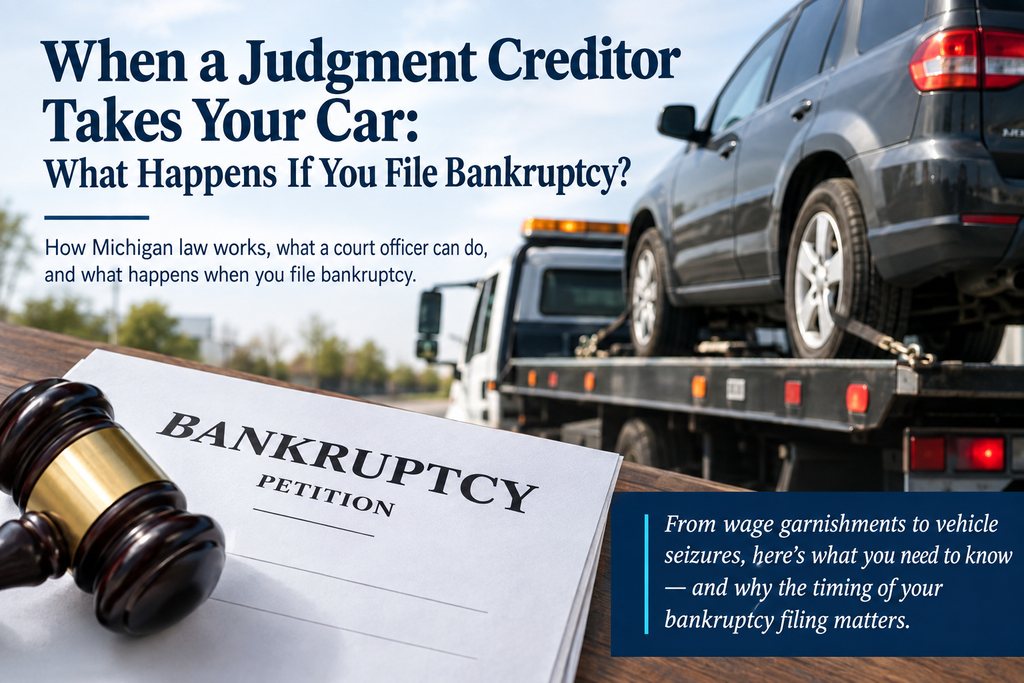
When a Judgment Creditor Takes Your Car: What Happens If You File Bankruptcy?

Published
One of the things I have learned after more than 30 years of practicing bankruptcy law is that people often underestimate what a creditor can do after obtaining a judgment.
Many people think that once a creditor gets a judgment against them, the creditor simply has to wait for the debtor to pay. That is not the case.
A judgment gives a creditor additional collection remedies. In Michigan, one of those remedies can ultimately result in a court officer coming to your home or other location and taking your personal property to be sold to satisfy the judgment.
And, in my experience, this is one of those situations where a person who is considering bankruptcy should not wait until the last minute.
Table of Contents
- What Does a Judgment Creditor Usually Try First?
- Michigan Law Allows a Judgment Creditor to Seize Property
- The Ohakpo Case
- Filing Bankruptcy Changes What Happens Next
- The Court Officer Cannot Simply Continue the Auction
- There Is a Catch: Towing and Storage Costs
- The Debtor May Still Have to Deal With the Towing Company
- What If the Vehicle Has Not Yet Been Sold?
- What Happens to the Vehicle in the Bankruptcy?
- Don’t Wait Until the Tow Truck Arrives
- Bankruptcy Can Stop the Collection Process—But Timing Matters
- My Advice to Someone Facing a Judgment
What Does a Judgment Creditor Usually Try First?
When a creditor has a judgment, the creditor will generally look for the easiest source of money.
The first choices are often things such as:
- Garnishing the debtor’s wages;
- Levying against money in the debtor’s bank account;
- Intercepting a Michigan income tax refund; or
- Pursuing other assets that can be reached through the judgment collection process.
If the creditor is successful with a wage garnishment, for example, the creditor can receive money from each paycheck until the judgment is paid or the garnishment otherwise terminates.
A bank account levy can be even more disruptive because the debtor can suddenly discover that money they needed to pay their mortgage, rent, utilities, groceries or other bills has been taken.
The same thing can happen with a Michigan income tax refund.
But what happens when the creditor tries these remedies and there simply isn’t enough money there?
The creditor may start looking at the debtor’s property.
Michigan Law Allows a Judgment Creditor to Seize Property
Michigan law provides a procedure for enforcing a judgment against personal property.
Michigan Compiled Laws § 600.6001 provides that when a judgment is entered, an execution may be issued to the sheriff, bailiff or other proper officer to collect the judgment.
This is the mechanism that can lead to a writ or order directing a sheriff or court officer to seize and sell nonexempt personal property.
That can include automobiles.
The process is more serious than simply receiving another collection letter.
A court officer can be directed to locate property belonging to the judgment debtor, seize it, and proceed toward a sale.
Judge Phillip Shefferly of the United States Bankruptcy Court for the Eastern District of Michigan explained this process very clearly in a 2013 opinion involving two automobiles.
The Ohakpo Case
In In re Ohakpo, Chapter 7 Case No. 12-66874, Judge Shefferly considered what happens when a judgment creditor has already taken a debtor’s automobiles before the debtor files bankruptcy.
The facts are striking.
RBS Citizens, N.A. had obtained a judgment against Simeon Ohakpo in the amount of $23,146.29. The state court then issued an order directing a court officer to seize and sell Mr. Ohakpo’s personal property to satisfy the judgment.
On December 9, 2012, the court officer seized two automobiles from the debtors’ residence—a 2008 Ford Escape and a 2008 Lexus.
The officer obtained appraisals, towing arrangements were made, and a notice of sale was posted.
But the cars were never sold.
Why?
The debtors filed Chapter 7 bankruptcy on December 12, 2012—only three days after the automobiles had been seized.
Filing Bankruptcy Changes What Happens Next
This is where Ohakpo becomes particularly important.
Once the bankruptcy case was filed, the state court officers still had possession of the vehicles. The officers acknowledged that they had a legal obligation to turn the automobiles over because the vehicles had become property of the bankruptcy estate.
The court explained that, in a Chapter 7 case, property of the estate is to be turned over to the Chapter 7 trustee, rather than simply returned directly to the debtor.
That is an important distinction.
A Chapter 7 debtor does not automatically get to say, “I filed bankruptcy, so give me my car back.”
The vehicle becomes part of the bankruptcy estate, and the trustee is the representative of that estate.
In Ohakpo, the court officers ultimately turned the automobiles over to the Chapter 7 trustee.
The Court Officer Cannot Simply Continue the Auction
This is the practical point that I want people to understand.
If a vehicle has been seized pursuant to a judgment before the bankruptcy is filed, but the vehicle has not yet been sold, the bankruptcy filing changes the situation.
The judgment creditor and its court officer do not simply get to proceed with the auction as though the bankruptcy had never been filed.
The Bankruptcy Code’s automatic stay and the provisions governing custodians of property come into play.
Judge Shefferly determined that the court officer who had actually been authorized by the state court to seize the automobiles was a “custodian” under § 101(11)(C) of the Bankruptcy Code.
The court concluded that the Michigan execution and levy process created a charge against the seized property that qualified as a lien under the Bankruptcy Code. In other words, the seizure was not merely a physical taking of the cars—it created what the court characterized as a possessory execution lien against the automobiles.
But being a custodian did not mean that the court officer could simply sell the cars after the bankruptcy was filed.
The Bankruptcy Code required the custodian to turn the property over to the bankruptcy trustee, subject to the custodian’s rights to seek appropriate relief from the bankruptcy court.
There Is a Catch: Towing and Storage Costs
This is where things get interesting—and where debtors need to understand that filing bankruptcy does not necessarily make every expense associated with a seized vehicle disappear.
When a court officer takes a vehicle, someone has to pay the towing and storage company.
And those charges can become substantial.
In Ohakpo, the court officer had incurred towing and storage charges totaling $2,039.50 for the two automobiles.
The court ultimately determined that the court officer was entitled to reimbursement of those actual costs, along with a $32 statutory fee.
But there was an important limitation.
Judge Shefferly rejected the court officer’s request to make the debtors personally liable for these costs and rejected the request to make the obligation nondischargeable.
The court explained that Michigan law did not impose personal liability upon the judgment debtor for the court officer’s fees and costs associated with the seizure. Instead, the costs could be recovered from the seized property and its proceeds.
That is a very important distinction.
The Debtor May Still Have to Deal With the Towing Company
People sometimes hear that the bankruptcy filing means the creditor has to give the car back and assume that means the car will immediately be sitting in their driveway again.
It may not work that way.
If the vehicle has already been seized and is sitting in a towing or storage facility, there can be significant towing and storage expenses associated with the vehicle.
In Ohakpo, the court records show that each vehicle initially generated a $256 towing charge, followed by additional towing and storage charges of $763.75 per vehicle.
Those expenses do not simply vanish because the debtor filed bankruptcy.
Judge Shefferly explained that Michigan law provides a mechanism for payment of the court officer’s costs from the proceeds of the seized property. The bankruptcy court can also address payment of a custodian’s reasonable costs under § 543(c)(2).
So a debtor who has had a vehicle seized should immediately find out:
Where is my vehicle?
Who has possession of it?
How much are the towing and storage charges?
Has the vehicle been sold yet?
Has a sale been scheduled?
Those questions can be extremely important.
What If the Vehicle Has Not Yet Been Sold?
This is one of the most important distinctions in this area.
There is a substantial difference between:
A vehicle that has been seized but has not yet been sold, and
A vehicle that was actually sold before the bankruptcy was filed.
In Ohakpo, the automobiles had been seized, but the bankruptcy was filed before the scheduled sale occurred. Consequently, the vehicles were not auctioned off by the court officer.
Instead, they were turned over to the Chapter 7 trustee.
Judge Shefferly’s opinion specifically concluded that the court officer’s payment rights were an in rem charge against the automobiles, subject to valid liens and other charges having priority under applicable nonbankruptcy law.
“In rem” is a legal term that is important here.
It essentially means the claim attaches to the property itself rather than creating a personal debt against the debtor.
The court specifically rejected the request for a nondischargeable personal judgment against the debtors for the court officer’s fees and costs.
What Happens to the Vehicle in the Bankruptcy?
Once the vehicle is turned over to the Chapter 7 trustee, the trustee has to determine what should happen with it.
That depends upon the circumstances.
Is there a loan on the vehicle?
How much is the vehicle worth?
How much is owed on the loan?
Is there an execution lien?
Is the vehicle exempt?
Is there equity for the bankruptcy estate?
These are all questions that have to be examined.
In the Ohakpo case, the Ford Escape was valued at $5,000 and was claimed exempt by the debtor. The Lexus was valued at $19,000, but the debtors listed a secured claim of $25,673 against it and did not claim it exempt.
Those facts demonstrate why you cannot simply look at the value of a vehicle and assume that the creditor will be able to take it.
There may be exemptions, secured liens and other issues that affect whether there is any equity available to creditors.
Don’t Wait Until the Tow Truck Arrives
I have represented many people over the years who waited too long to address their financial problems.
They knew there was a judgment.
They knew the creditor was trying to collect.
They may already have experienced a wage garnishment or bank levy.
But they hoped that somehow things would get better.
Then one morning they walk outside and discover that their vehicle is gone.
At that point, the situation becomes much more complicated.
If you are already dealing with a judgment creditor, you should not assume that the creditor’s only remedy is a wage garnishment.
A creditor may eventually move against your property.
And if a vehicle has already been seized, the timing of a bankruptcy filing can become particularly important.
Bankruptcy Can Stop the Collection Process—But Timing Matters
A bankruptcy filing triggers the automatic stay, which generally prevents creditors from continuing collection activity against the debtor.
But when a court officer has already seized property before the bankruptcy filing, there can be additional bankruptcy issues involving the property, the officer’s status as a custodian, the automatic stay, the trustee’s rights, and the officer’s claim for costs.
Ohakpo provides an excellent example.
The court officer had physically seized the vehicles before the bankruptcy was filed. The automobiles had not yet been sold. After the bankruptcy was filed, the vehicles were turned over to the Chapter 7 trustee rather than being auctioned by the judgment creditor’s court officer.
At the same time, the court recognized the court officer’s right to recover appropriate costs associated with the seizure.
That is why this is not simply a matter of saying, “File bankruptcy and get your car back.”
The actual circumstances matter.
My Advice to Someone Facing a Judgment
If you have a judgment against you and the creditor is actively trying to collect, do not ignore it.
If your wages are being garnished, your bank account is being levied, your Michigan tax refund is being intercepted, or you have received information that a creditor is attempting to seize your property, you should understand your options before the situation gets worse.
And if a court officer has already seized your automobile, call a bankruptcy attorney immediately.
Find out whether the vehicle has been sold.
Find out where the vehicle is located.
Find out what towing and storage charges have accumulated.
And find out whether filing bankruptcy can stop the sale and protect whatever interest you have in the vehicle.
The Ohakpo decision by Judge Shefferly demonstrates that the timing of the bankruptcy filing can make a very real difference.
A creditor may have gone all the way through the judgment process and actually seized your vehicle. But if the vehicle has not yet been sold when the bankruptcy is filed, the bankruptcy court—not the judgment creditor—may ultimately determine what happens to that vehicle.
That can be a very important distinction when you are trying to protect your property and get a fresh start.
If you are facing a judgment, wage garnishment, bank levy, tax refund interception, or an attempted seizure of your vehicle, don’t wait until the creditor has already taken your property before getting legal advice.
This article discusses general bankruptcy principles and the facts of the cited case. Every case is different, particularly with respect to exemptions, liens, vehicle equity and the timing of a seizure and bankruptcy filing.