I Filed Bankruptcy Almost 20 Years Ago. Why Is My Second Mortgage Still on My House?

Published
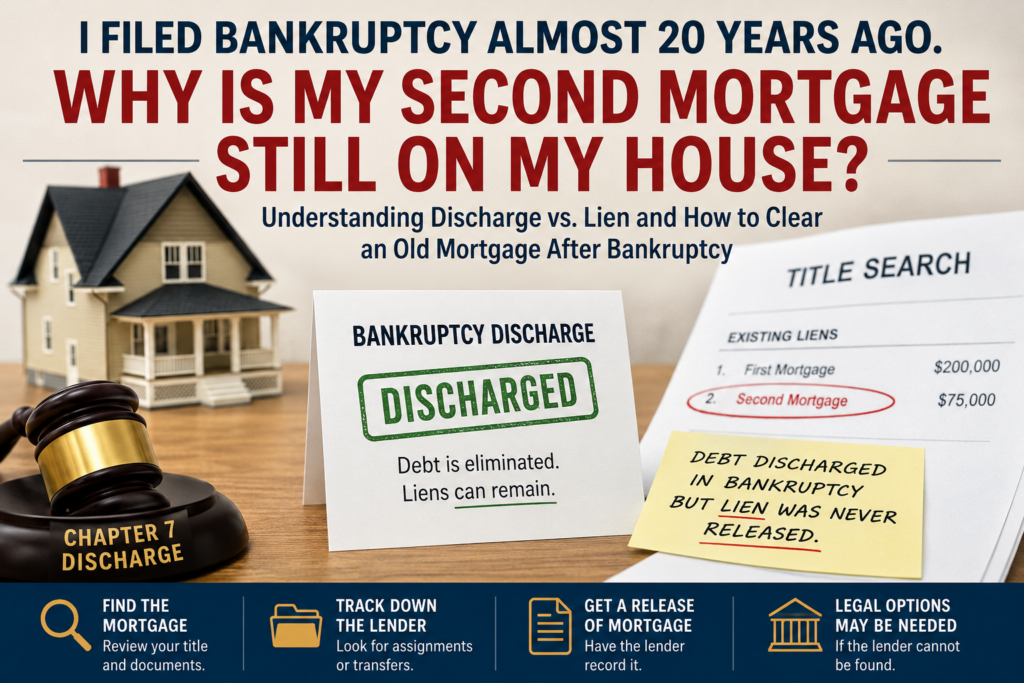
Over the past several years, I have heard from a number of former bankruptcy clients who are facing a problem they never expected.
They filed Chapter 7 bankruptcy during the foreclosure crisis. Their bankruptcy case was successfully completed. They received their discharge. Their second mortgage debt was discharged in bankruptcy. In many cases, they never heard another word from the second mortgage company.
Then, nearly 20 years later, they decided to sell their home.
They found a buyer. They signed a purchase agreement. They started working with a title company.
And then the title company found an old second mortgage lien.
Suddenly, the sale of the house is in jeopardy.
The homeowner quite reasonably asks:
“How can there still be a mortgage on my house? I filed bankruptcy and the mortgage debt was discharged almost 20 years ago!”
This is a situation I am seeing more frequently, particularly with homes that were subject to second mortgages during the Great Recession and the foreclosure crisis.
Unfortunately, the answer is not as simple as many homeowners believe.
Table of Contents
- Bankruptcy Discharges the Debt — But It Does Not Automatically Remove the Mortgage Lien
- So What Happened to These Old Second Mortgages?
- “But They Never Came After Me”
- What Makes This Problem Especially Difficult Today?
- Some Homeowners Were Given Lien Release Letters
- What Can You Do If You Have an Old Second Mortgage?
- What If the Mortgage Company Is Out of Business?
- Don’t Assume the Lien Will Just Go Away Because the Debt Was Discharged
- If You Are Thinking About Selling, Deal With the Problem Early
- The Bottom Line
Bankruptcy Discharges the Debt — But It Does Not Automatically Remove the Mortgage Lien
One of the most common misconceptions I hear from former bankruptcy clients is that bankruptcy eliminates their mortgage.
That is not quite correct.
A Chapter 7 bankruptcy discharge eliminates the debtor’s personal liability for most dischargeable debts. But a bankruptcy discharge does not automatically eliminate a valid mortgage lien against the debtor’s real estate.
There is an important distinction between the debt and the lien.
For example, suppose you borrowed $100,000 from a mortgage lender and gave the lender a mortgage on your home as security for the loan.
You later file Chapter 7 bankruptcy.
Your personal obligation to pay that $100,000 debt may be discharged.
But the mortgage lien does not simply disappear because you received a bankruptcy discharge.
This distinction makes sense when you think about how mortgages work.
If filing bankruptcy automatically eliminated mortgage liens, mortgage lenders would have a very difficult time lending money to homeowners in the first place.
A mortgage lender makes a loan based upon the borrower’s promise to repay and the lender’s security interest in the property. The mortgage is the lender’s collateral.
The bankruptcy discharge generally prevents the lender from pursuing you personally for the discharged debt. It does not, by itself, give you a house free and clear of an otherwise valid mortgage lien.
So What Happened to These Old Second Mortgages?
During the foreclosure crisis, many homeowners found themselves owing considerably more on their homes than their homes were worth.
A homeowner might have had:
- A first mortgage of $200,000;
- A second mortgage or home equity line of $75,000;
- And a house worth only $150,000.
The homeowner might then file Chapter 7 bankruptcy.
The $75,000 second mortgage debt could be discharged as a personal obligation.
But the second mortgage lien could remain attached to the property.
In many situations, the second mortgage lender recognized that there was little or no equity in the property behind the first mortgage. The lender therefore had little economic reason to foreclose.
The lender might have stopped sending statements.
It might have stopped making collection calls.
The homeowner might never have received another letter.
Eventually, the homeowner simply forgot about the second mortgage.
The bankruptcy case was closed.
Years went by.
The homeowner continued living in the house, paying the first mortgage, paying the taxes and insurance, and maintaining the property.
And then, almost 20 years later, the homeowner decided to sell.
That is when the old lien can come back to life as a title problem.
“But They Never Came After Me”
That is often exactly what happened.
And there is an important reason for that.
The second mortgage company may have realized that pursuing the homeowner personally was no longer worthwhile or, following the bankruptcy discharge, was no longer legally permissible.
The lender may also have had little incentive to foreclose because the first mortgage consumed all of the available equity.
So the second mortgage simply sat there.
The homeowner heard nothing.
But the mortgage document that had been recorded with the county was still sitting in the public land records.
The bankruptcy discharge did not necessarily cause that mortgage to be removed from the county’s records.
That is the distinction that can cause so much trouble years later.
What Makes This Problem Especially Difficult Today?
The foreclosure crisis occurred roughly 15 to 20 years ago.
A lot has changed since then.
Mortgage companies have merged.
Banks have failed or been acquired.
Mortgage servicing rights have been sold.
Loan portfolios have been transferred.
Companies have changed their names.
Some lenders and servicers that existed during the foreclosure crisis no longer exist at all.
This can make finding the current owner of an old second mortgage extremely difficult.
I have had former clients tell me:
“I don’t even know who the mortgage company is anymore.”
Sometimes they have an old statement or a bankruptcy document with the name of the original lender.
Sometimes all they have is the recorded mortgage itself.
And sometimes the title company is the first party to tell them that the lien even still exists.
Some Homeowners Were Given Lien Release Letters
There is another wrinkle to this problem.
During and shortly after the Great Recession, some second mortgage lenders sent homeowners letters indicating that the mortgage had been satisfied, released, forgiven or otherwise would no longer be enforced.
Those letters can be extremely valuable today.
Unfortunately, in many cases, the homeowner received a letter but the mortgage company never recorded a formal release of mortgage with the county.
That means the homeowner may have a piece of paper saying that the lender released the obligation, while the county’s land records still show the mortgage as an outstanding lien.
From the homeowner’s perspective, the mortgage was gone.
From the title company’s perspective, the lien is still there.
And when you are selling a house, the title company is generally going to want the title cleaned up before the closing.
What Can You Do If You Have an Old Second Mortgage?
The first thing I recommend is do not panic.
An old mortgage appearing on a title search does not necessarily mean that you have to pay the old debt.
Remember the distinction:
The bankruptcy discharge and the mortgage lien are two different things.
The first step is to obtain a copy of the recorded mortgage and determine exactly what is shown in the county land records.
You should also obtain a copy of your bankruptcy discharge and the relevant bankruptcy schedules so that you can establish what happened to the underlying debt.
The title company handling your sale may also be able to provide information concerning the recorded mortgage, including the name of the original lender, recording information and assignment history.
1. Find the Original Mortgage
Start with the county Register of Deeds or the title company.
You want to identify:
- The original mortgage lender;
- The date the mortgage was recorded;
- The recording number or liber and page;
- The original borrower;
- The property;
- Any assignments of the mortgage;
- Any subsequent releases or discharges.
This information gives you a starting point for determining who may now own or control the mortgage.
2. Determine Whether the Original Lender Still Exists
The lender listed on the mortgage may no longer be in business.
That does not necessarily mean the lien disappeared.
The lender’s assets may have been purchased by another financial institution. The mortgage may have been assigned to another company. A loan servicer may have changed even though the underlying owner of the loan did not.
This is where some investigation may be necessary.
3. Look for an Assignment
One of the most useful documents can be a recorded assignment of mortgage.
An assignment may show that the original mortgage was transferred to another lender or entity.
The county land records sometimes provide the trail needed to determine where the mortgage went.
But not every mortgage has a neat and complete chain of assignments.
That is one reason these old foreclosure-era mortgages can become such a headache.
4. Search Your Old Bankruptcy Records
Your bankruptcy file can also be extremely helpful.
If you filed bankruptcy during the foreclosure crisis, your bankruptcy schedules may identify the second mortgage lender and the amount that was owed at the time.
Your bankruptcy discharge is particularly important because it establishes that your personal liability for the dischargeable debt was eliminated.
Keep in mind, however, that the discharge itself is not necessarily a document releasing the mortgage lien from the property.
5. Search Your Old Files for a Release Letter
If you still have boxes of old bankruptcy and mortgage documents, go through them.
Look for anything from the second mortgage company stating that the loan was paid, settled, forgiven, released or otherwise no longer enforceable.
Even if the lender failed to record the release, the letter may be extremely helpful in resolving the title issue.
Give copies to your title company and your attorney.
6. Contact the Current Mortgage Holder
If you can identify the current holder of the mortgage, you can request that the lender record an appropriate release or discharge of mortgage.
The lender may require documentation, including:
- A copy of your bankruptcy discharge;
- A copy of the recorded mortgage;
- Evidence concerning the history of the loan;
- A copy of an old release letter;
- Information from the title company;
- Or other documentation establishing that the mortgage should be released.
This process can take time.
If you are already under contract to sell your house, do not wait until the week before closing to start.
What If the Mortgage Company Is Out of Business?
This is where things can get considerably more complicated.
If the original second mortgage lender no longer exists, the question becomes:
Who currently owns the mortgage, or who has authority to release it?
Sometimes another financial institution acquired the lender’s assets.
Sometimes a successor can be identified through corporate records or the chain of assignments recorded with the county.
In other cases, it may be necessary to do considerably more investigation.
If nobody can be located who is willing or able to execute a release, the homeowner may need to explore legal options for clearing the title.
That is a situation where I recommend talking with an attorney who handles real estate and bankruptcy issues rather than simply assuming that the old mortgage can be ignored.
Don’t Assume the Lien Will Just Go Away Because the Debt Was Discharged
This is perhaps the most important lesson.
If you received a Chapter 7 discharge years ago, you may very well have no personal liability for the second mortgage debt.
But if the mortgage was never properly released or otherwise eliminated, the lien may still appear in the chain of title to your property.
And that can create a problem when you try to sell or refinance the property.
The title company is not necessarily saying that you owe the debt personally.
It is saying that there is a recorded interest in the property that needs to be addressed.
Those are two very different things.
If You Are Thinking About Selling, Deal With the Problem Early
If you own a home that was subject to a second mortgage during the foreclosure crisis and you are thinking about selling, I would recommend checking your title before you put the house on the market.
You may discover that an old mortgage is still sitting in the land records.
Finding that out six months before a sale is much better than finding it out three days before closing.
If you have an old bankruptcy discharge, old mortgage documents or correspondence from a second mortgage lender, keep them.
Those documents may be nearly 20 years old, but they could become very important when you eventually sell your home.
The Bottom Line
The foreclosure crisis may seem like ancient history to many homeowners.
But the legal documents created during that period can still affect property owners today.
A Chapter 7 bankruptcy discharge may have eliminated your personal obligation to pay a second mortgage, but that does not necessarily mean the mortgage lien was removed from the title to your home.
That is why I have recently heard from former clients who received their bankruptcy discharges many years ago, never heard another word from their second mortgage companies, and are now discovering that the old mortgage is still appearing on their title.
The good news is that discovering an old lien does not necessarily mean you have to pay the old mortgage.
It means that the title needs to be examined and the lien needs to be properly addressed.
If you are selling a home and the title company has discovered an old second mortgage from before or around the foreclosure crisis, don’t assume that your bankruptcy discharge solved the title problem.
Get your old bankruptcy records. Get a copy of the recorded mortgage. Find out who owns the lien today. Look for any old release letters. And if the lender cannot be located or will not release the lien, get legal advice about the appropriate way to clear the title.
After nearly 20 years, an old second mortgage may have been forgotten by everyone involved.
Except the county land records.