Published
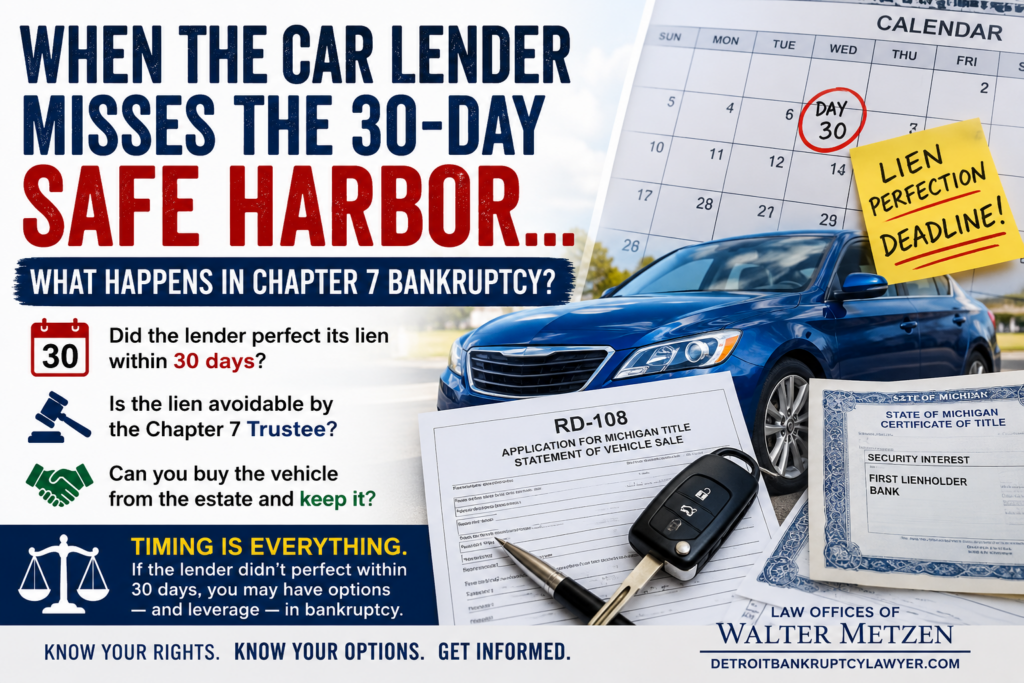
One of the more interesting situations I have encountered in Chapter 7 bankruptcy involves a debtor who recently purchased or financed a vehicle shortly before filing bankruptcy, only to discover that the automobile finance company did not properly perfect its lien within the 30-day period provided by the Bankruptcy Code.
This can create a very unusual situation.
The debtor may owe $20,000 or $30,000 on the vehicle. The debtor may assume that the finance company has a valid lien because the dealer told him everything was taken care of. But if the lender did not properly perfect its security interest before the bankruptcy—and particularly if the lender failed to perfect within the statutory 30-day period—the Chapter 7 Trustee may have an opportunity to challenge that lien.
And sometimes, surprisingly, that can be very good news for the debtor.
Table of Contents
The 30-Day Safe Harbor
Section 547(c)(3) of the Bankruptcy Code contains an important exception for a purchase-money security interest.
Generally, if a lender finances the purchase of a vehicle and takes a security interest in that vehicle, the lender can avoid having its lien treated as a preferential transfer if the security interest is perfected on or before 30 days after the debtor receives possession of the vehicle.
The reason for this provision is fairly simple.
Congress did not want an automobile lender to be punished merely because the lender took some time to complete the title and lien-recording process after a vehicle was purchased.
But that protection has a deadline.
If the lender misses the 30-day period, the situation changes dramatically.
A simple example
Suppose a Michigan debtor purchases a vehicle on January 1.
The debtor receives possession of the vehicle on January 1 and signs all of the financing documents at the dealership.
The lender is supposed to obtain and perfect its lien through the Michigan title system.
But something goes wrong.
The lender does not actually perfect its security interest until February 15.
The debtor files Chapter 7 on February 20.
Now we have a problem.
The lender did not perfect within 30 days after the debtor received possession.
If the debtor’s bankruptcy filing occurs within 90 days of the eventual perfection, the Trustee may have a potential preference argument under §547. The Bankruptcy Code generally permits a Chapter 7 Trustee to avoid certain transfers made within 90 days before bankruptcy that enable a creditor to receive more than it would have received in a Chapter 7 case.
But there is an additional—and potentially even more powerful—problem for the lender.
The Trustee may be able to argue that the lender’s lien was unperfected as of the bankruptcy filing and therefore avoidable under the Trustee’s strong-arm powers under §544.
That is where things can become very interesting.
The Michigan RD-108 Is Important
In Michigan, automobile liens are handled through the Michigan Secretary of State’s title system.
The RD-108 Application for Michigan Title – Statement of Vehicle Sale is one of the documents involved in the vehicle title and lien process.
This is important because I have had clients tell me:
“The dealership gave me all of the paperwork. The bank has my loan. Surely they have a lien.”
That does not necessarily answer the bankruptcy question.
The question is not simply whether the debtor signed a financing agreement.
The question is whether the lender properly perfected its security interest.
Michigan’s title records are therefore extremely important in determining whether the lender actually has a perfected lien.
I have previously written about why Chapter 7 Trustees frequently request a copy of the vehicle title. The Trustee is not merely interested in the make, model and value of the vehicle. The Trustee may also be checking whether the lender’s lien has actually been perfected. In the Eastern District of Michigan, Trustees will sometimes accept an RD-108 when a debtor cannot immediately obtain a copy of the title, although the actual title is preferable.
Michigan’s Secretary of State also maintains information concerning vehicle titles and liens.
What If the Debtor Files Bankruptcy Before the Lien Is Perfected?
This is where the timing becomes extremely important.
Let’s say:
Day 1: Debtor purchases vehicle.
Day 1: Debtor signs retail installment contract.
Day 1: Finance company advances the money.
Day 15: Dealer submits title paperwork.
Day 31: Lender’s lien still has not been perfected.
Day 40: Debtor files Chapter 7.
The lender cannot simply assume that it can now take its time and perfect the lien after bankruptcy.
The bankruptcy filing invokes the automatic stay.
There are statutory exceptions involving certain acts of perfection, including provisions found in §§362(b)(3) and 546(b), but those provisions have to be carefully analyzed in conjunction with §547 and the applicable state perfection law.
This is why the precise dates matter so much.
What Happens If the Lender Eventually Perfects the Lien?
Suppose the debtor files Chapter 7 on Day 40.
The lender then gets around to recording its lien on Day 45.
The lender may argue:
“We have a lien now.”
That does not necessarily end the inquiry.
The Trustee can examine when the transfer is deemed to have occurred for bankruptcy purposes.
Section 547(e) contains rules determining when a transfer is considered to have been made. Among other things, when perfection occurs more than 30 days after the security interest becomes effective, the transfer is generally treated differently than one perfected within the statutory period. If the interest remains unperfected at the commencement of the bankruptcy case and the applicable statutory period has expired, the Bankruptcy Code contains provisions that can cause the transfer to be treated as occurring immediately before the petition.
That can put the lender squarely inside the preference period.
And that is precisely why the 30-day deadline matters.
The Trustee Has Some Powerful Options
The Chapter 7 Trustee does not automatically have to take the vehicle.
The Trustee first has to determine whether there is actually something worth pursuing.
There are several possibilities.
Option One: The Trustee Does Nothing
If the vehicle has little or no equity after considering the debtor’s exemption, the Trustee may decide that pursuing the lien is not economically worthwhile.
That is often the practical result.
The Trustee is administering an estate for the benefit of creditors. Trustees generally don’t want to spend substantial time and money litigating over a vehicle that produces little or nothing for unsecured creditors.
Option Two: The Trustee Challenges the Lien
If the vehicle has substantial equity, the Trustee may decide that the lender’s lien should be avoided.
For example:
Vehicle value: $30,000
Loan balance: $27,000
Debtor’s exemption: $3,000
At first glance, the debtor appears to have very little equity.
But suppose the lender’s lien is avoidable.
Now the analysis could be dramatically different because the Trustee may potentially administer the vehicle as property of the bankruptcy estate, subject to the debtor’s applicable exemption.
This is where a seemingly insignificant perfection problem can become a major bankruptcy issue.
Option Three: The Trustee Sells the Vehicle
If the Trustee determines that the vehicle has sufficient nonexempt value, the Trustee can potentially sell the vehicle and administer the proceeds.
This is obviously not what most debtors want.
Most people need their vehicles to get to work, take their children to school, go to medical appointments and simply live their lives.
That is why a debtor should not assume that the Trustee’s discovery of a defective lien automatically means:
“I’m losing my car.”
It doesn’t necessarily mean that.
There may be another solution.
Option Four: The Debtor Buys the Vehicle From the Estate
This is one of the more interesting possibilities.
Suppose the Trustee believes the vehicle has significant value because the lender’s lien may be avoidable.
The Trustee could potentially sell the estate’s interest in the vehicle.
The debtor may have an opportunity to negotiate with the Trustee to purchase the vehicle from the bankruptcy estate.
And this is where the situation can sometimes become a surprisingly good deal for the debtor.
Here’s an example.
Suppose:
Vehicle value: $25,000
Lender claims: $23,000
Debtor’s exemption: $5,000
Potential nonexempt equity: approximately $20,000 if the lender’s lien is successfully avoided
The Trustee may initially believe that there is substantial value to administer.
But the debtor might have other arguments, including the applicable exemption, valuation disputes, costs of sale, the uncertainty and expense of litigation, and the question of what the Trustee could actually obtain if the vehicle were sold.
The debtor’s attorney may be able to negotiate a settlement with the Trustee.
Perhaps instead of the debtor losing a $25,000 vehicle, the debtor can pay the Trustee a negotiated amount and keep the vehicle.
That amount could potentially be considerably less than the amount the debtor would otherwise have to pay to the automobile lender.
This is one of those situations where a bankruptcy problem can turn into an opportunity.
Could the Debtor Get the Car for Less Than the Loan Balance?
Potentially, yes—but this requires a very careful analysis.
The debtor should not think:
“The bank didn’t perfect its lien, so I get a free car.”
That is not how it works.
The Trustee represents the bankruptcy estate, not the debtor.
If the Trustee has a legitimate claim that the lender’s lien is avoidable, the Trustee may have an asset worth administering.
The debtor’s objective is then to determine what it would cost to resolve the Trustee’s interest in that asset.
There can be substantial negotiating room.
The Trustee has to consider:
- the vehicle’s actual fair market value;
- the debtor’s available exemption;
- the lender’s claim;
- whether the lien is actually avoidable;
- the cost of litigating with the lender;
- the likelihood of success;
- the costs of repossession and sale;
- auction or dealership sale expenses;
- the amount ultimately available for unsecured creditors; and
- whether a negotiated settlement produces a better result for the estate.
The debtor, meanwhile, wants to keep the vehicle for the lowest reasonable amount.
This is where having an experienced bankruptcy attorney can make a substantial difference.
The Finance Company Has Defenses Too
It is important not to assume that the Trustee automatically wins.
The finance company may have defenses.
The precise nature of the transaction matters.
Was this actually a purchase-money security interest?
When did the debtor receive possession?
When did the lender’s security interest attach?
When was the title application submitted?
When was the lien actually recorded?
Was there an error by the dealership rather than the lender?
Was the lender’s lien actually perfected under Michigan law before the bankruptcy?
Did the applicable perfection provisions permit a postpetition perfection?
Are there other provisions of the Bankruptcy Code that protect the transaction?
These questions can make the difference between a valid lien and an avoidable lien.
Don’t Forget the Dealer’s Paperwork
This is one reason I tell my clients to give me everything they received when they purchased the vehicle.
That includes:
- The purchase agreement;
- Retail installment contract;
- Financing agreement;
- RD-108;
- Temporary registration;
- Title documents;
- Lien documents;
- Payoff information for a trade-in;
- Correspondence from the lender;
- Correspondence from the dealership;
- Any electronic title information; and
- Anything showing when the transaction was submitted to the Michigan Secretary of State.
The RD-108 can be particularly important because it may help establish what was submitted, when it was submitted and how the transaction was intended to be processed.
But an RD-108 sitting in the debtor’s bankruptcy file does not by itself establish that the lender has a perfected security interest. The actual title and Michigan Secretary of State records may ultimately be more important.
What Should a Debtor Do?
If you purchased a vehicle shortly before filing Chapter 7, do not try to hide the vehicle or the financing transaction from the Trustee.
Disclose it.
Provide the Trustee with the title information and financing documents.
If the lender failed to perfect its lien, that is something the bankruptcy attorney and Trustee need to know.
The debtor should also not contact the lender and tell them that their lien is defective before discussing the situation with bankruptcy counsel.
Sometimes the best strategy is to allow the Trustee to investigate the issue.
Other times, the lender may have a perfectly valid defense.
And sometimes the best outcome is a negotiated settlement in which the debtor pays the Trustee an amount that is substantially less than the outstanding automobile loan and walks away from the transaction owning a vehicle free of the lender’s lien.
The Bottom Line
A recently purchased automobile can create some very unusual issues in a Chapter 7 bankruptcy.
The Bankruptcy Code gives a purchase-money automobile lender a 30-day safe harbor for perfection. If the lender properly perfects within that period, §547(c)(3) generally protects the security interest from being avoided as a preference.
But when the lender misses that deadline—and the debtor files bankruptcy within the applicable preference period—the Trustee may have significant leverage.
The Trustee may investigate the lien, challenge its perfection, pursue avoidance under the Bankruptcy Code, or determine that the vehicle isn’t worth administering.
And if the Trustee determines that the vehicle has value to the bankruptcy estate, the debtor may have another option that many people don’t realize exists:
The debtor may be able to negotiate with the Trustee to purchase the vehicle from the bankruptcy estate.
In the right case, that can produce a remarkable result.
Instead of continuing to owe a finance company $25,000 or $30,000, a debtor might be able to negotiate a substantially smaller payment to the Trustee, keep the vehicle, and emerge from the bankruptcy with a vehicle that is no longer encumbered by the lender’s lien.
Of course, every case depends upon the particular facts, the vehicle’s value, the debtor’s exemptions, the timing of perfection, the nature of the financing transaction and the Trustee’s assessment of the estate’s potential recovery.
This is a situation where dates matter—and sometimes a great deal of money is hiding in those dates.
This article is for general informational purposes and is not legal advice. The application of the Bankruptcy Code’s lien-perfection and preference provisions depends upon the particular facts of each case, including applicable state law.