In re Rembert: The Sixth Circuit Bankruptcy Decision Every Michigan Gambler With Debt Should Know

Published
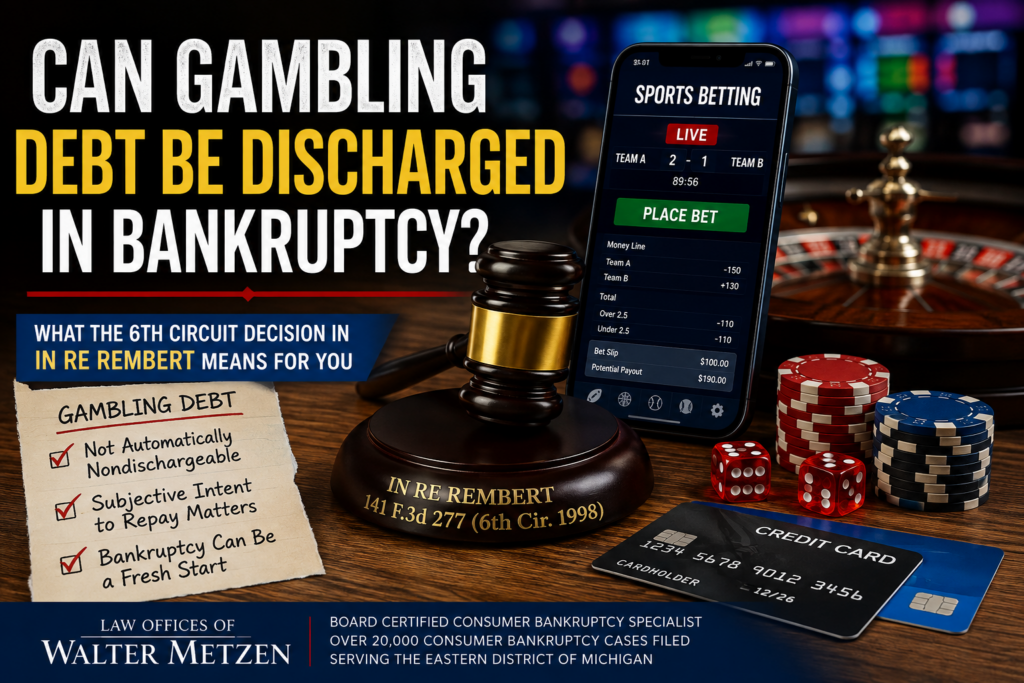
One of the things I hear from clients who come to my office with significant gambling debt is this:
“I know I can’t discharge gambling debt in bankruptcy.”
That statement is usually made with complete confidence. Unfortunately, it is not correct.
There is no general rule in the Bankruptcy Code that says gambling debt cannot be discharged. In fact, the United States Court of Appeals for the Sixth Circuit — the federal appellate court that governs Michigan bankruptcy cases — addressed this very issue in In re Rembert, 141 F.3d 277 (6th Cir. 1998).
The Rembert case is an important case for anyone who has accumulated substantial debt through gambling. And with the explosion of online casinos, internet gambling and legalized sports betting, I believe the case is more important today than it was when the Sixth Circuit decided it nearly 30 years ago.
The Rembert Case
Benethel Rembert was employed by Chrysler Motors and had been experiencing financial difficulties. She had credit cards with Citibank and AT&T Universal Card Services.
During a period when she was struggling financially, she obtained cash advances from her credit cards and used the money for gambling.
She eventually filed Chapter 7 bankruptcy.
The credit card companies objected to the discharge of the debts, arguing that the debts were obtained through fraud and therefore should be excepted from discharge under § 523(a)(2)(A) of the Bankruptcy Code.
The bankruptcy court initially agreed with the credit card companies and determined that the debts were nondischargeable.
The case eventually made its way to the Sixth Circuit.
The Sixth Circuit reversed that decision.
Gambling Does Not Automatically Make a Debt Nondischargeable
This is the part of Rembert that I think is particularly important for my clients to understand.
The Sixth Circuit did not say that gambling debt is automatically nondischargeable.
Instead, the court focused on the question of whether the debtor subjectively intended to repay the debt when the debt was incurred.
That distinction is extremely important.
A person can make a terrible financial decision. A person can gamble away money that should have been used to pay the mortgage, the car payment or the credit cards. A person can make an irrational decision believing that the next hand, the next spin or the next sports bet will finally turn things around.
That does not automatically mean the person committed fraud when the credit card debt was incurred.
In Rembert, the debtor testified that she believed she would win enough money gambling to repay the credit card companies. The Sixth Circuit recognized that this belief may have been objectively unreasonable. But the question under § 523(a)(2)(A) was not simply whether her belief was reasonable.
The question was whether she actually intended to repay the money.
The Sixth Circuit held that the proper inquiry was the debtor’s subjective intent, which must be determined from the totality of the circumstances.
That is a very different question from simply asking:
“Did this person gamble with the money?”
“But I Used My Credit Card to Gamble”
I have had clients tell me that they are afraid to even discuss their gambling because they believe that doing so automatically makes their credit card debt nondischargeable.
That is not the law.
If you used a credit card to purchase groceries, the debt is generally a credit card debt.
If you used the credit card to pay your electric bill, it is generally a credit card debt.
And if you obtained a cash advance from the credit card and used that money to gamble, the fact that you gambled with the money does not, standing alone, answer the question of whether the resulting debt is dischargeable.
The creditor would still have to establish the requirements of § 523(a)(2)(A), including the necessary fraudulent intent.
That is precisely why Rembert is so important.
The Sixth Circuit recognized that gambling can create a unique situation because a compulsive gambler may genuinely believe that he or she will win enough money to pay the debt back. The court therefore required an examination of the debtor’s actual intent and the surrounding circumstances rather than simply assuming that gambling meant fraud.
Rembert Is Even More Important Today
When Rembert was decided in 1998, gambling was a very different business.
If somebody wanted to gamble, that person generally had to get in a car and drive to a casino, buy a lottery ticket, visit a racetrack or participate in some other traditional form of gambling.
Today, the casino can be in your pocket.
Online casinos and sports betting have made gambling available 24 hours a day, seven days a week.
A person can be sitting at home and place a sports wager in seconds. There is no longer necessarily a trip to Las Vegas or even a trip to a brick-and-mortar casino.
That accessibility has created a completely different environment for people who struggle with gambling.
I have seen clients who accumulated substantial credit card and loan debt because they kept believing that they could win back what they had already lost.
That is one of the most dangerous aspects of gambling debt.
A person loses $5,000 and thinks, “If I can just win $5,000, I will be back where I started.”
Then the person loses another $5,000.
Now the goal is to win $10,000.
Before long, the person is trying to win back $20,000, $30,000 or $50,000.
The debt can become overwhelming very quickly.
Bankruptcy Can Be the Relief Valve
This is where I believe bankruptcy serves an important purpose.
Bankruptcy is sometimes described as giving someone a “fresh start.”
I think that is exactly right.
For an honest but unfortunate debtor, bankruptcy is intended to provide a way out of overwhelming debt.
That does not mean bankruptcy excuses fraud. It does not.
If someone intentionally runs up credit cards with no intention whatsoever of paying them back and files bankruptcy shortly thereafter, there can be serious dischargeability issues.
But that is different from someone who got caught in a cycle of gambling, genuinely believed that the next win would allow him or her to repay the debt, eventually realized that the situation had become impossible and sought the protection of the Bankruptcy Code.
Rembert recognizes that distinction.
What About a Gambling Addiction?
There is another issue that I discuss with clients when gambling is a significant part of the bankruptcy.
If someone has a gambling problem, the financial problem is only part of the problem.
It is one thing to discharge $50,000 or $100,000 of credit card debt.
It is another thing to discharge that debt and then immediately begin gambling again.
If the underlying problem has not been addressed, the person can find himself right back where he started.
For that reason, when I have a client whose bankruptcy is substantially related to gambling, I generally want to know what the client is doing to address the gambling.
Has the gambling stopped?
Has the client recognized that there is a problem?
Has the client sought counseling or treatment?
Is the client attending a support program?
Has the client taken steps to prevent access to gambling applications or websites?
These things can be extremely important.
Courts and trustees are understandably interested in whether a debtor is actually dealing with the underlying problem rather than simply using bankruptcy as a temporary financial reset.
I would not suggest that there is an automatic Bankruptcy Code requirement that every person with gambling debt must complete a particular treatment program before filing bankruptcy. There isn’t.
But when gambling is a substantial factor in the bankruptcy, evidence that the debtor has recognized the problem and taken meaningful steps to address it can be very important.
It also makes common sense.
The purpose of bankruptcy is to give someone a fresh start — not to provide someone with a fresh supply of credit cards to gamble with.
Honesty Is Critical
There is one thing I cannot emphasize enough.
You have to be honest with your bankruptcy attorney.
If gambling is responsible for a significant portion of your debt, tell your attorney.
Don’t try to hide it.
Don’t leave gambling transactions off your schedules.
Don’t try to explain away large cash withdrawals without telling your attorney where the money went.
And don’t assume that because you are embarrassed about the gambling that your attorney is going to judge you.
I have been doing this for a very long time. People get into financial trouble for all sorts of reasons.
My job is not to judge my clients.
My job is to understand what happened, determine whether bankruptcy is appropriate and, if it is, make sure the case is filed honestly and correctly.
That is particularly important in a gambling-related bankruptcy because the circumstances surrounding the debt may be examined closely.
The Bottom Line
Gambling debt is not automatically nondischargeable in bankruptcy.
That is the lesson of In re Rembert.
The Sixth Circuit’s decision requires an examination of the debtor’s subjective intent and the totality of the circumstances when a creditor claims that gambling-related debt was incurred through fraud.
That does not mean every gambling debt will be discharged.
It does mean that you should not assume that your gambling debt is automatically excluded from bankruptcy.
And in today’s world of online casinos and readily available sports betting, this issue is likely to become increasingly important.
If gambling has caused you to accumulate more debt than you can possibly repay, don’t assume that you have no options.
Bankruptcy is there as a relief valve for honest but unfortunate debtors.
The important thing is to be completely honest about what happened, stop digging the hole deeper and get professional advice about your options.
In re Rembert, 141 F.3d 277 (6th Cir. 1998), is a reminder that a person’s financial mistake — even a very serious one — does not necessarily mean that person is permanently trapped by the resulting debt.