Beware of Fake Collection Calls: The Growing Scam Targeting Consumers in Financial Distress

Published
One of the most troubling trends I have seen in recent years is the dramatic increase in fake collection call scams targeting people who are struggling financially. Unfortunately, these scammers know exactly who to target. They often prey on people who are behind on bills, have recently experienced financial hardship, or may be considering bankruptcy.
These scams have become much more sophisticated. Years ago, it was usually easy to identify a scam call because the person on the other end sounded unprofessional or had very little information about you. That is no longer the case.
Today’s scammers often have access to a surprising amount of personal information. They may know your full name, address, date of birth, the last four digits of your Social Security number, names of family members, old addresses, and even information about debts you may actually owe. This information makes the caller sound legitimate and can cause people to panic and believe they are dealing with a real collection agency.
Common Warning Signs of a Fake Debt Collector
While every situation is different, there are several red flags that should immediately make you suspicious.
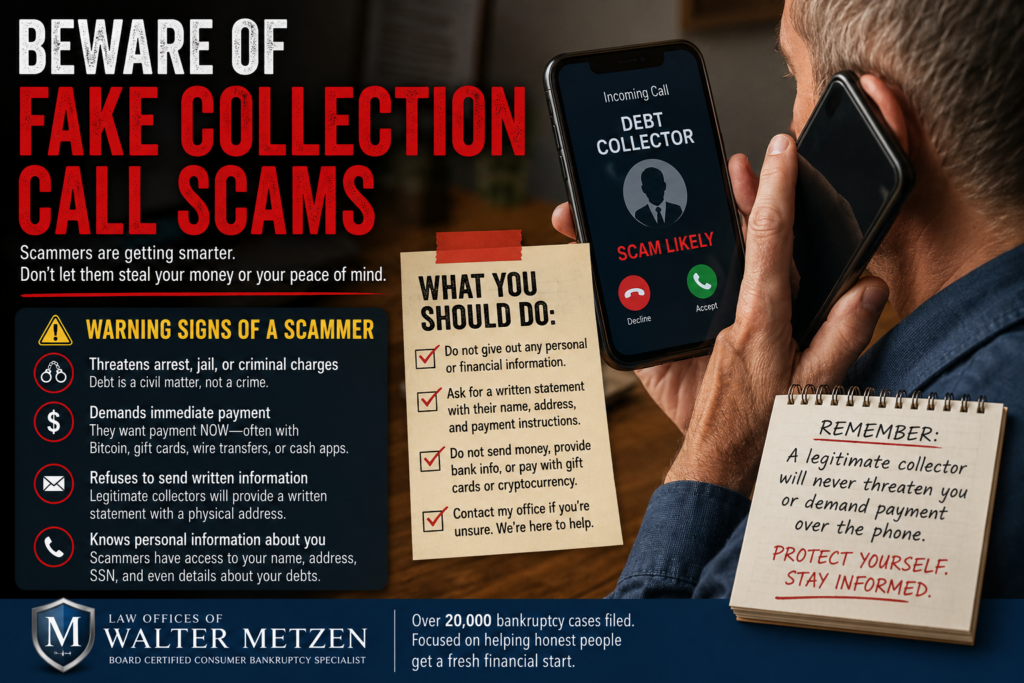
They threaten arrest or criminal charges
A legitimate debt collector cannot threaten to have you arrested because you owe a consumer debt. Debt collection is a civil matter, not a criminal matter.
Scammers often use fear as their main weapon. They may tell you:
- A warrant has been issued for your arrest;
- The police are on their way;
- You will be served with court papers unless you pay immediately;
- You will lose your job, driver’s license, or be charged with a crime.
These statements are designed to make you panic and stop you from thinking clearly.
They demand immediate payment
A legitimate collection agency may request payment, but a scammer usually demands that you pay immediately while you are on the phone.
They may insist on payment through unusual methods such as:
- Bitcoin or other cryptocurrency;
- Gift cards;
- Wire transfers;
- Cash apps;
- Providing your bank account information over the phone.
These are major warning signs. Once you give this information, your money may be gone and difficult or impossible to recover.
They refuse to send written information
One of the simplest ways to test whether you are dealing with a legitimate collector is to ask for written verification.
Tell them:
“I would like you to send me a written collection letter with your company name, physical mailing address, the amount you claim I owe, and instructions on where payment should be mailed.”
A legitimate collection company should have no problem providing written information.
Scammers almost never want to do this because a physical address and written documentation make it much easier to identify them and report the fraud. Instead, they will pressure you to pay immediately.
What Happens When You Tell a Scam Caller You Filed Bankruptcy?
Unfortunately, bankruptcy clients are often targeted after filing bankruptcy because scammers know that people who have financial problems may be more vulnerable to pressure.
I have had clients tell me that after they informed a caller that they had filed bankruptcy and instructed the caller to contact my office, the scammer responded with statements such as:
- “Your bankruptcy did not go through.”
- “We were not included in your bankruptcy.”
- “Your bankruptcy does not protect this debt.”
- “You still have to pay us today.”
These statements are often completely false.
A scammer does not care about the bankruptcy process. Their goal is to create fear and urgency so that you send money before you have time to verify anything.
If you have filed bankruptcy through my office and someone contacts you about a debt, do not assume the caller is legitimate simply because they know personal information about you. Contact my office and allow us to determine whether the claim is real and whether the creditor was properly included in your bankruptcy filing.
What Should You Do If You Receive a Suspicious Collection Call?
The best response is simple: do not argue with the caller and do not provide any personal or financial information.
Instead, say something like:
“I do not handle collection matters over the phone. Please send me a written statement showing the debt, your company name, your physical mailing address, and where payment should be sent.”
Then end the call.
Do not provide:
- Your Social Security number;
- Bank account information;
- Credit card numbers;
- Online banking information;
- Payment through gift cards or cryptocurrency.
If the caller becomes angry, threatens you, or refuses to send written information, that is a strong indication that you are dealing with a scam.
Remember: Bankruptcy Does Not Require You to Pay a Stranger Over the Phone
One of the biggest mistakes people make when they receive these calls is allowing fear to take over. Scammers are experts at creating a sense of urgency. They want you to believe that you must make a decision immediately.
You do not.
Legitimate creditors and collection agencies follow legal procedures. They send notices. They provide documentation. They do not demand Bitcoin payments, gift cards, or immediate access to your bank account while threatening arrest.
If you receive a collection call after filing bankruptcy, especially one that seems aggressive or threatening, contact my office before taking any action. A few minutes of verification can prevent you from losing hundreds or thousands of dollars to a scammer.
The bankruptcy process is designed to give honest people a fresh financial start. Do not allow a dishonest caller to take advantage of the very financial stress that led you to seek bankruptcy protection in the first place.