How Is a Chapter 7 Bankruptcy Trustee Compensated in the Eastern District of Michigan?

Published
One question I occasionally hear from clients is: How does the Chapter 7 Bankruptcy Trustee get paid? After all, the Trustee is responsible for reviewing the bankruptcy petition, conducting the 341 Meeting of Creditors, investigating the debtor’s financial affairs, and, when appropriate, identifying and liquidating nonexempt assets for the benefit of creditors.
It is a good question, and the answer is actually fairly interesting.
The compensation of a Chapter 7 Bankruptcy Trustee is governed primarily by federal bankruptcy law. There are two principal sources of compensation: a relatively small statutory payment in every qualifying case, including no-asset cases, and a percentage-based commission when the Trustee actually recovers and distributes money or property to creditors and other interested parties.
Let’s take a closer look at how this works in the Eastern District of Michigan.
Table of Contents
- 1. Most Chapter 7 Bankruptcy Cases Are No-Asset Cases
- 2. The Trustee’s Compensation in a No-Asset Chapter 7 Case: $120
- 3. The Chapter 7 Trustee’s Percentage Commission in Asset Cases
- Chapter 7 Trustee Commission Calculator
- 4. The Trustee Usually Has to Hire an Attorney to Recover Assets
- 5. Does the Trustee’s Compensation Come Out of the Debtor’s Pocket?
- 6. Why This Matters When Considering Chapter 7 Bankruptcy
- The Bottom Line
1. Most Chapter 7 Bankruptcy Cases Are No-Asset Cases
First, it is important to understand that the overwhelming majority of Chapter 7 bankruptcy cases filed in the Eastern District of Michigan are what we call “no-asset” cases.
A no-asset case does not mean that the debtor owns absolutely nothing. Most people filing Chapter 7 bankruptcy own vehicles, household furnishings, clothing, bank accounts, retirement accounts, and sometimes even a home.
Rather, a no-asset case means that, after applying the available bankruptcy exemptions, there is no nonexempt property available for the Chapter 7 Trustee to liquidate and distribute to creditors.
For example, a debtor might own a home with substantial equity, but that equity may be entirely protected by the applicable Michigan or federal bankruptcy exemptions. The same may be true of vehicles, retirement accounts, and other property.
In those circumstances, the Trustee does not have an asset to sell, and the case is administered as a no-asset Chapter 7 bankruptcy.
This is an important distinction because the Trustee’s compensation in a no-asset case is very different from the compensation available when the Trustee actually recovers assets.
2. The Trustee’s Compensation in a No-Asset Chapter 7 Case: $120
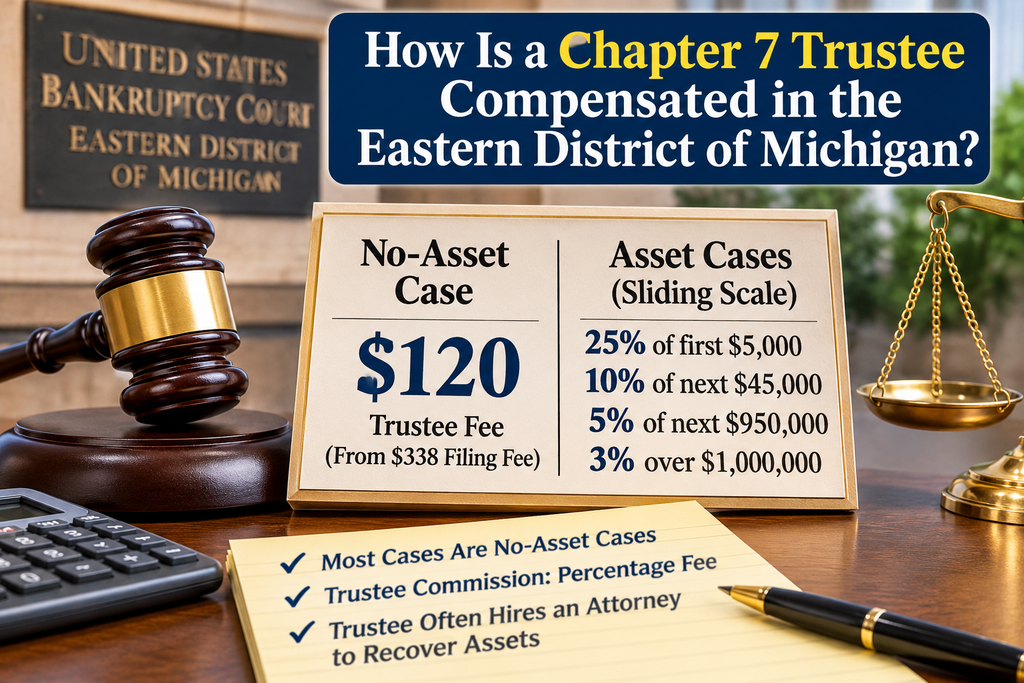
For Chapter 7 cases filed on or after October 1, 2026, the statutory flat compensation for the Chapter 7 Trustee is $120.
This amount is funded through the bankruptcy filing fee, rather than being an additional charge imposed on the debtor.
As of the date of this article, the total Chapter 7 filing fee is $338. Of that amount, the Trustee’s statutory compensation is $120.
In other words, when a Chapter 7 case is filed and the Trustee determines that there are no nonexempt assets to administer, the Trustee’s basic compensation is $120.
This is a relatively modest amount when you consider the responsibilities involved.
The Trustee must review the bankruptcy schedules and financial disclosures, examine the debtor under oath at the 341 Meeting of Creditors, investigate potential assets, and determine whether there is any property that can be administered for creditors.
In many cases, that work is completed without the Trustee ever recovering a dollar for creditors.
It is worth emphasizing that this $120 payment is not an additional fee that the debtor must pay directly to the Trustee. It is part of the statutory compensation structure funded through the bankruptcy system.
3. The Chapter 7 Trustee’s Percentage Commission in Asset Cases
Things become considerably more interesting when the Trustee discovers assets that are not protected by bankruptcy exemptions.
If the Trustee recovers money or property for the bankruptcy estate and distributes funds to creditors, secured creditors, attorneys, or other interested parties, the Trustee may be entitled to additional compensation based upon a percentage of the money distributed.
This percentage commission is governed by 11 U.S.C. § 326(a).
Congress established a sliding scale that allows the Trustee to receive a decreasing percentage as the amount of money distributed increases.
The statutory sliding scale is as follows:
Chapter 7 Trustee Commission Sliding Scale
- 25% of the first $5,000 distributed.
- 10% of the next $45,000 distributed.
- 5% of the next $950,000 distributed.
- 3% of any amount distributed in excess of $1,000,000.
These percentages are maximum statutory limits, not an automatic entitlement to payment of those amounts. The Bankruptcy Court must approve reasonable compensation under 11 U.S.C. § 330.
Let’s look at a couple of examples.
Example 1: The Trustee Recovers $20,000
Assume the Trustee recovers $20,000 in nonexempt assets and ultimately distributes that amount to interested parties.
The maximum percentage compensation under the sliding scale would be:
- 25% of the first $5,000 = $1,250.
- 10% of the next $15,000 = $1,500.
Total potential Trustee commission: $2,750.
Example 2: The Trustee Recovers $100,000
Assume the Trustee recovers $100,000 and distributes that amount to interested parties.
The maximum percentage compensation would be:
- 25% of the first $5,000 = $1,250.
- 10% of the next $45,000 = $4,500.
- 5% of the remaining $50,000 = $2,500.
Total potential Trustee commission: $8,250.
As you can see, the percentage commission can become substantial when the Trustee administers a significant amount of money.
It is important to understand that the calculation is based on money distributed or turned over by the Trustee to parties in interest, excluding the debtor, but including secured creditors. It is not simply a percentage of the value of everything the debtor owns.
Chapter 7 Trustee Commission Calculator
Calculate the estimated Chapter 7 Trustee commission under 11 U.S.C. § 326(a).
Commission Breakdown
| 25% of first $5,000 | $1,250.00 |
| 10% of next $45,000 | $4,500.00 |
| 5% of next $950,000 | $2,500.00 |
| 3% of amounts over $1 million | $0.00 |
This calculator estimates the maximum percentage commission under 11 U.S.C. § 326(a). Actual compensation is subject to Bankruptcy Court approval under § 330. The calculation is based on qualifying distributions to parties in interest, not simply the value of assets recovered. Separately approved attorney and professional fees are not included. The $120 no-asset case compensation is separate and is not added to this calculation.
4. The Trustee Usually Has to Hire an Attorney to Recover Assets
Another aspect of Chapter 7 Trustee compensation that many debtors do not understand is that the Trustee frequently has to hire an attorney to assist with the administration and recovery of assets.
Although Chapter 7 Trustees are experienced bankruptcy professionals, they are not necessarily attorneys, and even when they are attorneys, they generally do not personally perform all of the legal work required to administer an estate.
For example, suppose the Trustee discovers that a debtor owns a nonexempt interest in real estate, has an undisclosed personal injury claim, received an inheritance, or transferred property before filing bankruptcy.
Recovering those assets may require:
- Filing motions and other pleadings with the Bankruptcy Court.
- Initiating adversary proceedings or other litigation.
- Conducting discovery and taking depositions.
- Negotiating settlements with debtors, creditors, or third parties.
- Obtaining court approval for asset sales.
- Addressing liens, mortgages, and competing ownership interests.
- Preparing settlement agreements and other legal documents.
- Handling the administrative requirements associated with distributing funds to creditors.
In these circumstances, the Trustee will commonly employ either the Trustee’s own law firm or another local bankruptcy law firm to represent the Trustee and assist with recovering and administering the assets.
The attorney representing the Trustee is generally compensated separately from the Trustee’s percentage commission.
The attorney must seek approval of compensation from the Bankruptcy Court under the applicable provisions of 11 U.S.C. § 330, and the fees must be reasonable and for actual and necessary services.
These professional fees are ordinarily paid from the bankruptcy estate, subject to court approval and the availability of funds.
Consequently, when a Trustee recovers assets, there may be several expenses associated with administering the estate, including the Trustee’s commission, attorney fees, and other necessary professional and administrative expenses.
This is one reason why the amount ultimately distributed to unsecured creditors may be considerably less than the gross amount initially recovered by the Trustee.
5. Does the Trustee’s Compensation Come Out of the Debtor’s Pocket?
This is another question worth addressing.
In a typical no-asset Chapter 7 case, the debtor does not personally pay the Trustee’s $120 compensation. It is funded through the bankruptcy filing fee.
Likewise, in an asset case, the Trustee’s percentage commission and approved professional expenses are generally paid from the bankruptcy estate before the remaining funds are distributed to creditors.
That does not mean that the debtor can ignore the potential consequences of having nonexempt assets.
If the Trustee identifies property that is not protected by an applicable exemption, that property may be subject to liquidation. The resulting proceeds may be used to pay the expenses of administering the estate, including Trustee compensation and professional fees, before creditors receive their distributions.
In some cases, the debtor may be able to negotiate an agreement with the Trustee to purchase the estate’s interest in an asset rather than have it sold. Whether that makes financial sense depends on the particular circumstances.
This is another reason why proper exemption planning before filing bankruptcy is so important.
6. Why This Matters When Considering Chapter 7 Bankruptcy
I have represented thousands of individuals in Chapter 7 bankruptcy cases throughout my career, and one of the most important aspects of preparing a successful Chapter 7 filing is making certain that the debtor’s property is properly identified and that all available exemptions are considered.
People sometimes assume that if they own a home, have a vehicle, maintain bank accounts, or have other assets, they cannot file Chapter 7 bankruptcy.
That simply is not true.
The question is not whether you own property. The question is whether that property has nonexempt value that the Trustee can legally recover for the bankruptcy estate.
Properly applied bankruptcy exemptions frequently protect the assets that people are most concerned about losing.
In fact, most of the Chapter 7 cases I handle are no-asset cases. The Trustee conducts the examination, determines that there are no nonexempt assets available for liquidation, and the case proceeds toward discharge.
Understanding how Trustees are compensated also helps explain why they investigate potential assets and, when appropriate, employ attorneys to pursue them. Their compensation in asset cases is tied to the money they actually distribute, subject to statutory limits and court approval.
The Bottom Line
Chapter 7 Bankruptcy Trustees in the Eastern District of Michigan are not paid a salary for each individual case. Their compensation is governed by federal law.
In a typical no-asset Chapter 7 case filed on or after October 1, 2026, the Trustee receives $120 in statutory compensation funded through the bankruptcy filing fee.
When the Trustee recovers and distributes assets, the Trustee may receive additional compensation based on the sliding scale established by 11 U.S.C. § 326(a). The Trustee will also frequently employ attorneys and other professionals to assist with recovering and administering those assets, with their compensation subject to separate court approval.
The important takeaway for someone considering Chapter 7 bankruptcy is that owning property does not automatically mean that you will lose it. Properly identifying and applying the available exemptions is critical.
I have practiced bankruptcy law exclusively for more than 35 years and have represented more than 25,000 people in bankruptcy matters. I regularly handle Chapter 7 cases throughout the Eastern District of Michigan and understand how the local Chapter 7 Trustees administer these cases.
If you are considering bankruptcy and are concerned about your home, vehicles, retirement accounts, or other property, I encourage you to obtain experienced bankruptcy advice before making any decisions.
Walter Metzen
Board-Certified Specialist in Consumer Bankruptcy
Law Offices of Walter Metzen
Detroit, Michigan
313-962-4656
https://detroitbankruptcylawyer.com