What Is an Order Extending Time to Pay the Bankruptcy Case Filing Fee in a Bankruptcy Case?

Published
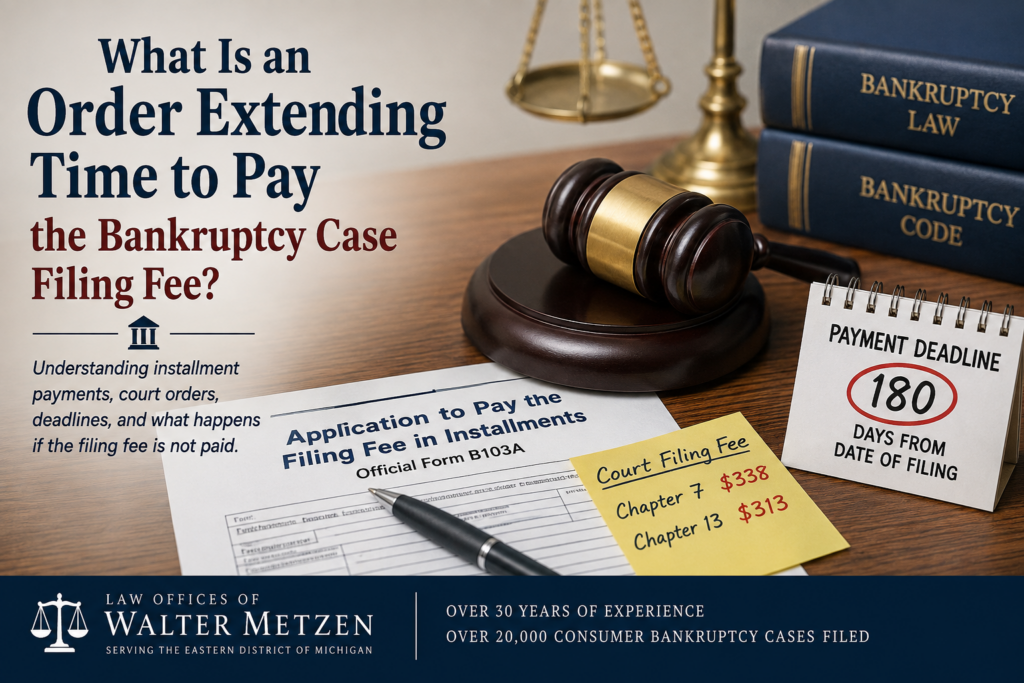
One question I receive from bankruptcy clients is, “What is this Order Extending Time to Pay the Bankruptcy Filing Fee, and do I need to be concerned about it?”
In many bankruptcy cases filed in the Eastern District of Michigan, a debtor does not pay the entire bankruptcy court filing fee on the day the case is filed. Instead, the debtor files an Application to Pay the Filing Fee in Installments and asks the Bankruptcy Court for permission to pay the filing fee over time.
The Eastern District of Michigan specifically provides for installment payments of bankruptcy filing fees.
For an individual debtor, the current filing fee is $338 for a Chapter 7 case and $313 for a Chapter 13 case.
Table of Contents
- Why Would Someone Pay the Filing Fee in Installments?
- What Happens After the Application Is Filed?
- What Does an Order Extending Time to Pay the Filing Fee Mean?
- The 180-Day Deadline Is Extremely Important
- What Happens If the Filing Fee Is Not Paid?
- You Will Not Receive Your Discharge Until the Filing Fee Is Paid
- What If the Case Is Dismissed?
- Don’t Ignore an Order From the Bankruptcy Court
- The Bottom Line
Why Would Someone Pay the Filing Fee in Installments?
The reason is usually simple: the debtor needs bankruptcy protection immediately but does not have the entire filing fee available.
For example, a person may be facing a garnishment, foreclosure, repossession, or aggressive collection activity and may need to file bankruptcy immediately. They may have enough money to pay some of the filing fee but not the entire amount.
The Bankruptcy Code permits an individual debtor to pay the filing fee in installments rather than paying the entire fee when the case is filed.
This can be very helpful because it allows a debtor to obtain the benefits of filing bankruptcy without having to come up with the entire court filing fee on the day the case is filed.
What Happens After the Application Is Filed?
When the bankruptcy case is filed, the debtor’s attorney will generally file the Application and Order for Individuals to Pay the Filing Fee in Installments, Official Bankruptcy Form B103A.
The Eastern District of Michigan recognizes this procedure for both Chapter 7 and Chapter 13 cases.
The Bankruptcy Court then has to determine how much time the debtor will have to pay the remaining filing fee.
In many cases, the Court will allow the debtor to make payments over several months. The Bankruptcy Court’s order will tell you exactly when the remaining balance must be paid.
This is where an Order Extending Time to Pay the Filing Fee can become important.
What Does an Order Extending Time to Pay the Filing Fee Mean?
An Order Extending Time to Pay the Filing Fee is essentially the Bankruptcy Court giving the debtor additional time to finish paying the court filing fee.
The Bankruptcy Rules generally contemplate that the filing fee will be paid within 120 days after the bankruptcy petition is filed. However, the Court can extend that period for cause, but the total period generally cannot exceed 180 days after the bankruptcy case is filed.
This distinction is important.
The 120-day period is the normal statutory time period for completing installment payments. A Bankruptcy Court can extend the time when appropriate, but the maximum period is generally 180 days.
In the Eastern District of Michigan, you will see some variation in how judges handle this issue. In some cases, a judge may issue an order giving the debtor additional time to pay the fee. In other situations, the Court may issue a Show Cause Order, requiring the debtor to explain why the case should not be dismissed because the filing fee has not been paid.
Other times, the Court simply enters an Order Extending Time in Which to Pay the Filing Fee to the Court and gives the debtor a specific deadline.
If you receive one of these orders, it does not necessarily mean that anything is wrong with your bankruptcy case. Very often, it is simply the Court establishing or extending the deadline for payment of the filing fee.
The 180-Day Deadline Is Extremely Important
Although the Bankruptcy Court may give you additional time, there is an absolute deadline that you need to understand.
The entire filing fee must be paid within the time permitted by the Bankruptcy Code and Bankruptcy Rules. The maximum extension generally permits payment through 180 days after the bankruptcy case was filed.
That deadline should not be treated casually.
If you have an order giving you until a particular date to pay the remaining filing fee, you need to make sure that the entire balance is paid by that deadline.
The Eastern District of Michigan now also provides an online payment option for certain court fees, including Chapter 7 and Chapter 13 filing-fee installment payments.
What Happens If the Filing Fee Is Not Paid?
This is the part that is particularly important.
If the debtor does not pay the entire filing fee by the required deadline, the bankruptcy case can be dismissed for failure to pay the filing fee.
The Clerk’s Office does not simply ignore the unpaid balance. The filing fee is a required court fee, and failure to pay it can result in dismissal of the bankruptcy case.
That means that a debtor who has successfully filed bankruptcy, obtained the protection of the automatic stay, attended the meeting of creditors, and otherwise proceeded through the bankruptcy case can still have the case dismissed because the filing fee was never completely paid.
That is a serious problem.
You Will Not Receive Your Discharge Until the Filing Fee Is Paid
Another important point that many people do not realize is that paying the bankruptcy filing fee is not merely an administrative detail.
If you are in a Chapter 7 case and are otherwise entitled to a discharge, you still need to have the bankruptcy filing fee paid.
You should not assume that because your Chapter 7 case has been pending for several months and everything else has been completed that you can simply ignore the unpaid filing fee.
The Bankruptcy Court will not enter the discharge while required conditions for the case remain outstanding, including an unpaid filing fee.
This is one reason I tell my clients to treat the filing-fee payment schedule just as seriously as every other deadline in their bankruptcy case.
What If the Case Is Dismissed?
This is the worst-case scenario.
If the debtor reaches the statutory deadline without paying the filing fee in full and the bankruptcy case is dismissed, the debtor may have to file a new bankruptcy case if bankruptcy protection is still needed.
That means paying another filing fee and starting the bankruptcy process over again.
There can also be other consequences associated with having a bankruptcy case dismissed and then having to file another case. Depending upon the circumstances, there can be issues involving the automatic stay and the timing of a subsequent bankruptcy filing.
For that reason, I would much rather see a client contact my office before the filing-fee deadline arrives if there is a problem making the payments.
Don’t Ignore an Order From the Bankruptcy Court
An Order Extending Time to Pay the Bankruptcy Filing Fee is usually not something to panic about.
In many cases, it simply means that the Bankruptcy Court has given you additional time to pay the filing fee that you were unable to pay when your bankruptcy case was filed.
But it is something you need to take seriously.
Read the order carefully. Look at the payment deadline. Determine how much remains due. And make sure the entire filing fee is paid by the deadline stated in the order and, in any event, within the maximum time permitted by the Bankruptcy Code and Bankruptcy Rules.
If you are my client and you receive a Show Cause Order or an Order Extending Time to Pay the Filing Fee, contact my office rather than assuming that the order can be ignored.
The Bottom Line
Paying the bankruptcy filing fee in installments is a useful option for people who need to file bankruptcy but do not have the entire court filing fee available immediately.
The current filing fee is $338 for Chapter 7 and $313 for Chapter 13. The Eastern District of Michigan permits individuals to request installment payments, and the Bankruptcy Court can establish a payment schedule.
The important thing to remember is that an installment arrangement does not eliminate the filing fee. It simply gives you additional time to pay it.
Most importantly, do not miss the final deadline. The Bankruptcy Code generally permits installment payments to be completed within 120 days, with the Court able to extend the period for cause up to a maximum of 180 days. If the filing fee is not paid as required, the bankruptcy case can be dismissed.
And if your case is dismissed because the filing fee was not paid, you may have no practical alternative but to file a new bankruptcy case if you still need bankruptcy protection.
That is why I consider an Order Extending Time to Pay the Filing Fee to be a routine order—but one that should never be ignored.