Can I Keep My Motorcycle If I File Bankruptcy?

Published
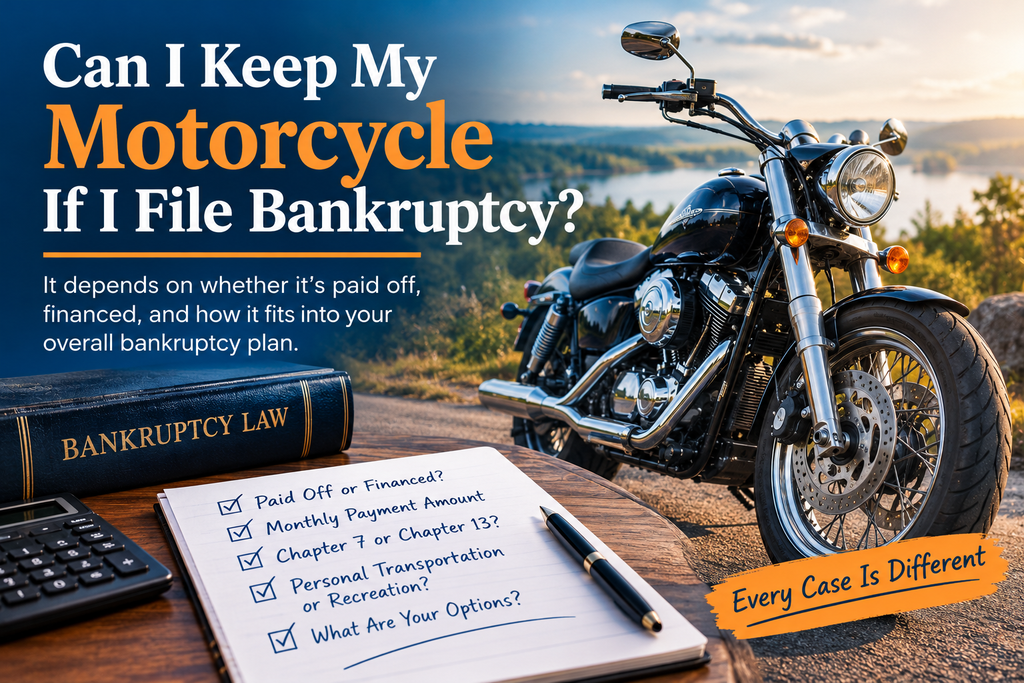
One question I occasionally hear from people considering bankruptcy is, “Can I keep my motorcycle if I file bankruptcy?”
The answer is generally yes, but there are some important issues to consider. It makes a difference whether your motorcycle is paid off or financed, how much it is worth, how much you owe on it, and whether you are filing Chapter 7 or Chapter 13 bankruptcy.
In my 35-year career representing more than 25,000 people in bankruptcy, I have seen a wide variety of situations involving motorcycles, ATVs, boats, recreational vehicles, and other toys. Some people use their motorcycles primarily for recreation, while others rely on them as their primary means of transportation.
Those differences can be important when determining whether you can keep the motorcycle and whether the expense of owning it will create a problem in your bankruptcy case.
Let me explain what you need to know.
Table of Contents
- Can I Keep a Paid-Off Motorcycle in Bankruptcy?
- What If I Still Owe Money on My Motorcycle?
- Can I Keep My Motorcycle in Chapter 13 Bankruptcy?
- Doesn’t the Bankruptcy Court Allow Some Money for Recreation?
- What About ATVs, Side-by-Sides, Boats, and Other Recreational Vehicles?
- My Advice If You Want to Keep Your Motorcycle
- Final Thoughts
Can I Keep a Paid-Off Motorcycle in Bankruptcy?
If your motorcycle is paid off, the first question is how much it is worth and whether you can protect its value using an applicable bankruptcy exemption.
When you file bankruptcy, you must disclose all your assets, including motorcycles, ATVs, dirt bikes, and other recreational vehicles. You cannot leave a motorcycle off your bankruptcy petition simply because you consider it a toy or believe it has little value.
In a Chapter 7 bankruptcy, a trustee is appointed to determine whether you have assets that are not protected by exemptions and can be sold for the benefit of your creditors.
For example, suppose you own a paid-off Harley-Davidson worth $12,000. Depending on the exemptions available to you, you may be able to protect all of its value, or some of that value may be exposed to a potential sale by the Chapter 7 trustee.
Michigan debtors may have a choice between applicable Michigan exemptions and the federal bankruptcy exemptions, subject to eligibility requirements. The exemption analysis needs to be done carefully because the amount you can protect depends on the exemption scheme selected, the nature of the property, and your individual circumstances.
If the motorcycle is fully exempt, the trustee generally has no economic reason to sell it for creditors. If it has substantial nonexempt equity, however, you could face a problem.
The important point is that owning a paid-off motorcycle does not automatically mean you will lose it in bankruptcy. The value of the motorcycle and the exemptions available to you are what matter.
What If I Still Owe Money on My Motorcycle?
If your motorcycle is financed, the analysis becomes more complicated.
You have two separate issues to consider:
- Can you protect the equity in the motorcycle from the bankruptcy trustee?
- Can you afford to continue making the payments, and will those payments create a problem under the bankruptcy rules?
Let’s look at each issue.
Chapter 7 Bankruptcy and Motorcycle Payments
In Chapter 7, you generally have to remain current on a secured loan if you want to keep the motorcycle, subject to the applicable rules governing secured creditors and the bankruptcy process.
However, there can be another issue: the size of the monthly payment.
Suppose you owe $18,000 on a motorcycle and have a monthly payment of $450. You are also seeking to eliminate $40,000 in credit card debt and personal loans.
The United States Trustee’s Office could question whether it is appropriate for you to continue making a substantial payment on a recreational vehicle while seeking to discharge your unsecured debts.
The argument is relatively straightforward: Why should you spend $450 every month to keep a motorcycle primarily used for recreation when that money could potentially be available to pay your creditors?
This issue may be particularly important if your income and expenses are being examined under the Chapter 7 means test or if the United States Trustee questions whether your financial circumstances justify Chapter 7 relief.
There is no universal rule that says a motorcycle payment above a particular dollar amount is automatically prohibited. Nor is every financed motorcycle considered a luxury item simply because it is not a car.
Nevertheless, a payment of several hundred dollars per month on a recreational motorcycle can attract scrutiny, particularly when the debtor has significant unsecured debt and limited disposable income.
The same concerns can arise with an expensive ATV, side-by-side, boat, or recreational vehicle.
Is a Motorcycle Always Considered a Luxury Item?
No. The circumstances matter.
I have represented debtors who used their motorcycles as their primary means of transportation for much of the year. Some did not have another vehicle and rode their motorcycles for nine months of the year, or even longer.
Motorcycles generally offer better fuel economy than cars, although actual savings depend on the particular motorcycle, the car being compared, insurance costs, maintenance, and how the vehicles are used.
If a motorcycle is your primary transportation and the payment is reasonable, it may be much easier to explain why keeping it is financially sensible than if you own a motorcycle strictly for weekend recreation.
For example, consider two debtors:
- Debtor A owns a motorcycle with a $450 monthly payment but also owns a newer pickup truck. The motorcycle is used primarily for weekend rides and recreation.
- Debtor B has a motorcycle with a $250 monthly payment and relies on it for daily transportation because it is economical to operate and the debtor does not own another vehicle.
Those situations are not necessarily going to be treated the same way. Debtor B has a stronger argument that the motorcycle is a reasonable transportation expense rather than a discretionary luxury.
That does not guarantee that the payment will be accepted in every case. It simply illustrates why the facts matter.
Can I Keep My Motorcycle in Chapter 13 Bankruptcy?
Chapter 13 presents a somewhat different analysis, but the monthly payment can still be an issue.
In Chapter 13, you propose a repayment plan that must satisfy the requirements of the Bankruptcy Code. Depending on your income, expenses, assets, and other circumstances, you may be required to pay some or all of your unsecured creditors through the plan.
A Chapter 13 trustee may question a substantial motorcycle payment if the trustee believes that the expense is unnecessarily reducing the amount available to unsecured creditors.
For example, suppose you have $500 per month available after accounting for your necessary living expenses, but you are also making a $400 monthly payment on a motorcycle used only for recreation.
The trustee may argue that you should not be spending that much on a recreational vehicle while paying little or nothing to your unsecured creditors.
If you are proposing to pay your unsecured creditors 100% of what they are owed, this particular objection may be less significant, assuming the plan otherwise satisfies the applicable legal requirements. But even a 100% repayment plan must meet the Bankruptcy Code’s other requirements, and the expense may still be examined.
If you are proposing to pay your unsecured creditors only a percentage of their claims, the trustee may have a stronger incentive to challenge an expense that could increase the distribution to creditors.
Ultimately, the treatment of the motorcycle payment depends on the circumstances of the case, the applicable plan requirements, and whether the proposed expenses are reasonable.
Doesn’t the Bankruptcy Court Allow Some Money for Recreation?
Yes. Bankruptcy law does not require you to spend every available dollar on necessities and give up every form of recreation.
The Chapter 13 schedules include Schedule J, which allows debtors to list their actual estimated monthly living expenses. These expenses can include recreation, entertainment, and other reasonable household expenditures.
The fact that a household has a recreational expense does not automatically make that expense improper.
However, there is a difference between allowing a reasonable amount for recreation and approving a large monthly payment on an expensive motorcycle while unsecured creditors receive little or nothing.
For example, if you and your family have modest recreational expenses and your motorcycle is your primary source of enjoyment, that may be a relevant consideration. It can help explain why some recreation is important to your household and why the expense should not automatically be eliminated.
But the amount still matters. A modest expense is easier to justify than a substantial payment on a high-end motorcycle, particularly if your budget is otherwise tight.
Also, Schedule J is not a blanket authorization to incur any recreational expense you choose. The court and trustee may examine whether your overall budget is reasonable and whether the plan complies with the applicable bankruptcy requirements.
What About ATVs, Side-by-Sides, Boats, and Other Recreational Vehicles?
The same general principles can apply to other recreational vehicles.
If you own a four-wheeler, an ATV, a side-by-side, a snowmobile, a boat, or an RV, you must disclose it in your bankruptcy schedules.
If the vehicle is paid off, the main concern may be whether its equity is protected by applicable exemptions.
If it is financed, you also need to consider the monthly payment and whether continuing to make that payment is reasonable under the circumstances of your case.
A debtor who owns an inexpensive ATV used occasionally for recreation may present a very different situation from a debtor who has several financed recreational vehicles with combined monthly payments of $1,000 or more.
There is no single rule that resolves every case. The value of the property, the loan balances, the payment amounts, the debtor’s income, and the proposed treatment of unsecured creditors all matter.
My Advice If You Want to Keep Your Motorcycle
If you are considering bankruptcy and want to keep your motorcycle, I recommend reviewing the situation before filing.
Here are some of the questions I would want answered:
- Is the motorcycle paid off, or is there a loan?
- What is the motorcycle worth today?
- How much do you owe on it?
- What is the monthly payment?
- Do you have another vehicle?
- Is the motorcycle used primarily for transportation or recreation?
- What is your household income?
- Are you considering Chapter 7 or Chapter 13?
- How much will your unsecured creditors receive under the proposed bankruptcy?
These questions help determine whether the motorcycle can be protected and whether the monthly payment could create a problem.
Sometimes, keeping the motorcycle is entirely reasonable. In other situations, the payment may be difficult to justify, and it may be necessary to consider other options.
The best approach is to evaluate the entire financial picture rather than assume that you must surrender your motorcycle simply because you are filing bankruptcy.
Final Thoughts
Can you keep your motorcycle if you file bankruptcy? In many cases, yes.
But whether you can keep it depends on more than whether you like riding it or whether you are current on the loan.
If it is paid off, we need to examine its value and the exemptions available to protect it. If it is financed, we also need to consider the payment and whether the expense is reasonable in light of your income, household needs, and obligations to creditors.
I have seen cases in which a motorcycle was a debtor’s primary means of transportation and the payment was entirely reasonable. I have also seen situations in which the cost of maintaining an expensive recreational vehicle could become a serious issue.
Every bankruptcy case is different, and the analysis must be made on a case-by-case basis.
If you live in Michigan and are considering Chapter 7 or Chapter 13 bankruptcy, it is worth having an experienced bankruptcy attorney review your circumstances before you file. A little planning before filing can help you avoid surprises and make a more informed decision about whether you can keep the motorcycle you want to retain.
Walter Metzen is a Michigan bankruptcy attorney whose practice focuses exclusively on bankruptcy. He has represented more than 25,000 clients during his 35-year career and represents individuals in Chapter 7 and Chapter 13 cases in the Eastern District of Michigan.