Which Michigan Bankruptcy Court District Do I File In? Eastern vs. Western District of Michigan

Published
When people call my office about filing bankruptcy, one of the first things I determine is where they live.
That is because bankruptcy is a federal proceeding, and Michigan is divided into two separate federal bankruptcy districts: the Eastern District of Michigan and the Western District of Michigan.
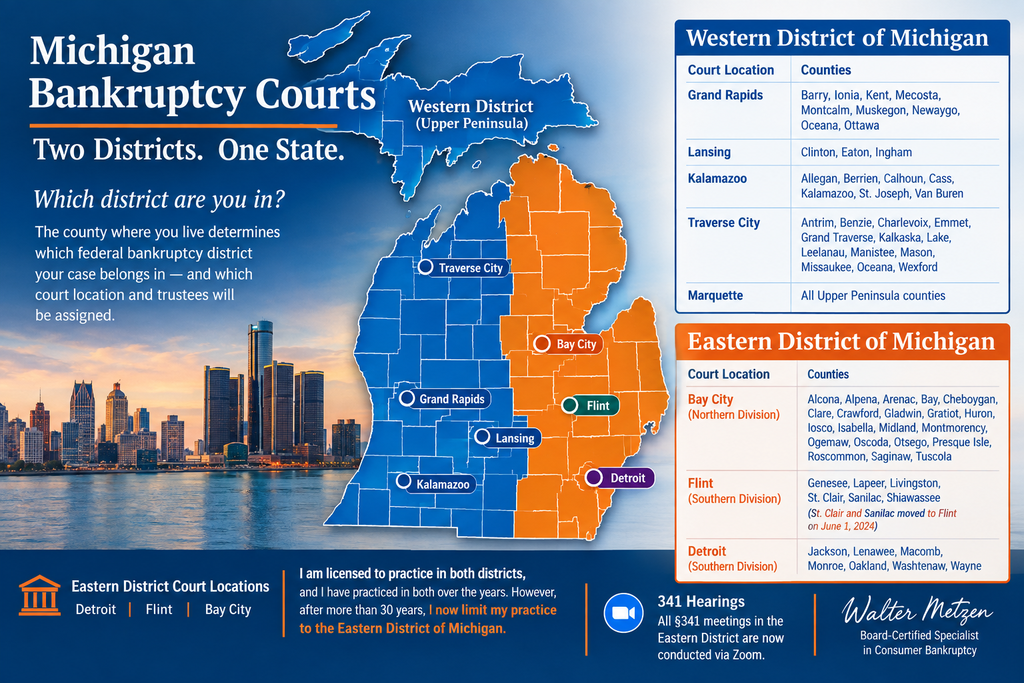
Which district your bankruptcy case belongs in generally depends upon the Michigan county in which you reside or are domiciled. The Eastern District covers the eastern portion of Michigan’s Lower Peninsula, while the Western District covers the western portion of the Lower Peninsula and the entire Upper Peninsula. The Eastern District currently consists of 34 counties.
This distinction is important because the bankruptcy court, bankruptcy judges, Chapter 7 trustees and Chapter 13 trustees assigned to your case depend upon the district and, in the Eastern District, the particular court location associated with your county.
Table of Contents
Michigan Has Two Federal Bankruptcy Districts
Michigan is unusual in that the state is divided between two federal bankruptcy districts.
Eastern District of Michigan
The Eastern District covers 34 counties in the eastern Lower Peninsula. The Bankruptcy Court has court locations in Detroit, Flint and Bay City.
Here is the current county breakdown:
| Eastern District of Michigan | Court Location |
|---|---|
| Alcona | Bay City |
| Alpena | Bay City |
| Arenac | Bay City |
| Bay | Bay City |
| Cheboygan | Bay City |
| Clare | Bay City |
| Crawford | Bay City |
| Gladwin | Bay City |
| Gratiot | Bay City |
| Huron | Bay City |
| Iosco | Bay City |
| Isabella | Bay City |
| Midland | Bay City |
| Montmorency | Bay City |
| Ogemaw | Bay City |
| Oscoda | Bay City |
| Otsego | Bay City |
| Presque Isle | Bay City |
| Roscommon | Bay City |
| Saginaw | Bay City |
| Tuscola | Bay City |
| Genesee | Flint |
| Lapeer | Flint |
| Livingston | Flint |
| St. Clair | Flint |
| Sanilac | Flint |
| Shiawassee | Flint |
| Jackson | Detroit |
| Lenawee | Detroit |
| Macomb | Detroit |
| Monroe | Detroit |
| Oakland | Detroit |
| Washtenaw | Detroit |
| Wayne | Detroit |
The Eastern District officially describes the northern portion as the Northern Division and the southern portion as the Southern Division. The Southern Division is served through the Detroit and Flint court locations, while the Northern Division is served through Bay City.
An Important Change for St. Clair and Sanilac Counties
There was an important change in 2024 that people should be aware of.
Beginning June 1, 2024, bankruptcy cases from St. Clair and Sanilac Counties were assigned to the Flint location rather than Detroit. The current Flint assignment is:
- Genesee
- Lapeer
- Livingston
- St. Clair
- Sanilac
- Shiawassee
The Detroit assignment is now:
- Jackson
- Lenawee
- Macomb
- Monroe
- Oakland
- Washtenaw
- Wayne
This change was made through Administrative Order 24-13 amending Eastern District of Michigan Local Bankruptcy Rule 1071-1.
This is particularly important when determining which bankruptcy trustee will be assigned to a case.
Western District of Michigan
The Western District of Michigan covers the western Lower Peninsula and all of Michigan’s Upper Peninsula.
The Western District has court locations associated with Grand Rapids, Lansing, Kalamazoo, Traverse City and Marquette.
Here is the county breakdown by court location:
| Western District Location | Counties |
|---|---|
| Grand Rapids | Barry, Ionia, Kent, Mecosta, Montcalm, Muskegon, Newaygo, Oceana, Ottawa |
| Lansing | Clinton, Eaton, Ingham |
| Kalamazoo | Allegan, Berrien, Calhoun, Cass, Kalamazoo, St. Joseph, Van Buren |
| Traverse City | Antrim, Benzie, Charlevoix, Emmet, Grand Traverse, Kalkaska, Lake, Leelanau, Manistee, Mason, Missaukee, Osceola, Wexford |
| Marquette | All counties in Michigan’s Upper Peninsula |
The Western District’s official court-location information identifies the counties assigned to each location, including all Upper Peninsula counties being assigned to Marquette.
Why Does the District Matter?
The district matters because a bankruptcy case is not simply filed in any federal bankruptcy court in Michigan.
The county where you live generally determines the proper venue for your bankruptcy case, and that in turn determines the bankruptcy court location, judge and trustee assignments.
For example, if you live in Oakland County, your bankruptcy case belongs in the Eastern District of Michigan and is assigned to the Detroit location.
If you live in Genesee County, your case belongs in the Eastern District and is assigned to Flint.
If you live in Kent County, your case belongs in the Western District and is assigned to Grand Rapids.
If you live in the Upper Peninsula, your case belongs in the Western District and is handled through the Marquette location.
What Does This Mean for My Bankruptcy Practice?
I am licensed to practice in the bankruptcy courts in both the Eastern and Western Districts of Michigan, and throughout my career I have practiced in both districts.
However, after more than 30 years of practicing bankruptcy law, I have chosen to limit my practice to the Eastern District of Michigan.
I believe there is a tremendous advantage to concentrating a bankruptcy practice in one district.
Bankruptcy law is federal law, but bankruptcy practice is also very local. Each bankruptcy court has its own local rules, procedures, judges, trustees, filing requirements and customs.
Over the course of more than three decades, I have had the opportunity to practice before the bankruptcy judges and trustees in the Eastern District of Michigan and to become familiar with the procedures followed in the District.
More Than 30 Years of Experience With the Eastern District Trustees
One of the things that I believe is particularly valuable to my clients is the amount of experience I have with the bankruptcy trustees in the Eastern District of Michigan.
I have been practicing before the Eastern District’s bankruptcy trustees for my entire career — more than 30 years.
I have dealt with these trustees and their offices through thousands of bankruptcy cases and have seen how bankruptcy cases have changed over the years.
The Eastern District currently maintains separate Chapter 7 trustee assignments for the Detroit and Bay City/Flint areas, as well as separate Chapter 13 standing trustees for the Detroit, Flint and Bay City locations.
That experience matters.
A bankruptcy attorney should not only understand the Bankruptcy Code. The attorney should understand how the bankruptcy process actually works in the particular district in which the case is being filed.
Your 341 Meeting Is Now Conducted by Zoom
Another major change over the years has been the way the §341 Meeting of Creditors is conducted.
The 341 meeting is the meeting at which the debtor is placed under oath and questioned by the bankruptcy trustee. Creditors have the right to attend and ask questions as well. The bankruptcy judge does not conduct the 341 meeting; the assigned trustee does.
Today, 341 meetings in the Eastern District of Michigan are conducted by Zoom.
The United States Trustee announced the expansion of virtual §341 meetings to Michigan in 2023, with Zoom being used for Chapter 7, 12 and 13 cases filed on or after September 1, 2023.
That means my clients generally do not have to drive downtown to Detroit or to Flint simply to attend their 341 meeting.
Instead, the debtor participates remotely from an appropriate location, using the Zoom information provided for the assigned trustee.
The meeting is still a formal bankruptcy proceeding. You are still under oath, and you still have to answer the trustee’s questions truthfully. The fact that the meeting takes place over Zoom does not make it any less important.
Why Experience With the Local Trustees Matters
I have always believed that bankruptcy is a very personal area of law.
When someone files bankruptcy, they are turning over an enormous amount of financial information to the court. Their income, assets, debts, bank accounts, tax returns, property, vehicles and financial history all become part of a federal court proceeding.
The attorney handling the case needs to understand not only the law but also the people and procedures involved in the local bankruptcy system.
I have been appearing in the Eastern District of Michigan for more than three decades.
During that time, I have practiced before the Eastern District’s bankruptcy judges and trustees, attended bankruptcy seminars and conferences, and represented thousands of people in Chapter 7 and Chapter 13 bankruptcy cases.
That is one of the reasons I have chosen to concentrate my practice exclusively in the Eastern District of Michigan today.
Do You Live in the Eastern or Western District?
If you are considering bankruptcy and are not sure which federal bankruptcy district you are in, the first thing to determine is your county of residence or domicile.
As you can see from the charts above, the dividing line is not simply “east side versus west side” in the ordinary geographic sense. The federal court districts have specific county assignments.
And even after determining that you are in the Eastern District, you need to know whether your case is assigned to Detroit, Flint or Bay City, because that affects the trustee assignment and other aspects of the administration of your case.
If you live in Wayne, Oakland, Macomb, Washtenaw, Monroe, Jackson or Lenawee County, your Eastern District case is assigned to the Detroit location.
If you live in Genesee, Lapeer, Livingston, St. Clair, Sanilac or Shiawassee County, your case is assigned to Flint.
If you live in one of the other Eastern District counties listed above, your case is assigned to the Bay City location.
The important point is that where you live determines where your bankruptcy case belongs.
If you are considering bankruptcy, I recommend determining the proper district and court location before filing anything. Filing a bankruptcy case is a federal legal proceeding, and the proper venue, trustee assignment and court procedures matter.
Walter Metzen
Attorney at Law
Board-Certified Specialist in Consumer Bankruptcy
Law Offices of Walter Metzen
This article is intended for general informational purposes and is not a substitute for legal advice concerning your particular circumstances.