How to Pay Your Mortgage Company After Filing Chapter 7 Bankruptcy

Published
One of the questions I frequently hear from clients after we file a Chapter 7 bankruptcy is: “How do I pay my mortgage now that I have filed bankruptcy?”
This is a very reasonable question. You want to keep your house, you want to remain current on your mortgage, and you certainly do not want a missed payment to result in a foreclosure.
The good news is that, in most Chapter 7 cases, continuing to make your mortgage payments is fairly simple once you understand what happens when the bankruptcy is filed.
Table of Contents
- Your Mortgage Must Be Listed in Your Bankruptcy
- What Happens to the Mortgage When You File Chapter 7?
- Your Mortgage Company May Stop Sending Statements
- Mortgage Companies Generally Want Your Money, Not Your House
- What Happens After the Bankruptcy Is Discharged?
- What Is a Mortgage Reaffirmation Agreement?
- Do I Have to Reaffirm My Mortgage to Keep My House?
- Can the Mortgage Company Foreclose If I Am Current?
- My Advice to My Chapter 7 Clients
Your Mortgage Must Be Listed in Your Bankruptcy
When you file bankruptcy, all of your creditors and debts must be listed in the bankruptcy petition. This includes debts that you intend to continue paying.
This is important because some people mistakenly think that if they want to keep their house and continue making their mortgage payments, they should leave the mortgage company off the bankruptcy schedules.
That is not correct.
Your mortgage company must be listed even though you intend to keep your home and continue making your mortgage payments.
The fact that the mortgage is listed does not mean that you are giving up your house.
What Happens to the Mortgage When You File Chapter 7?
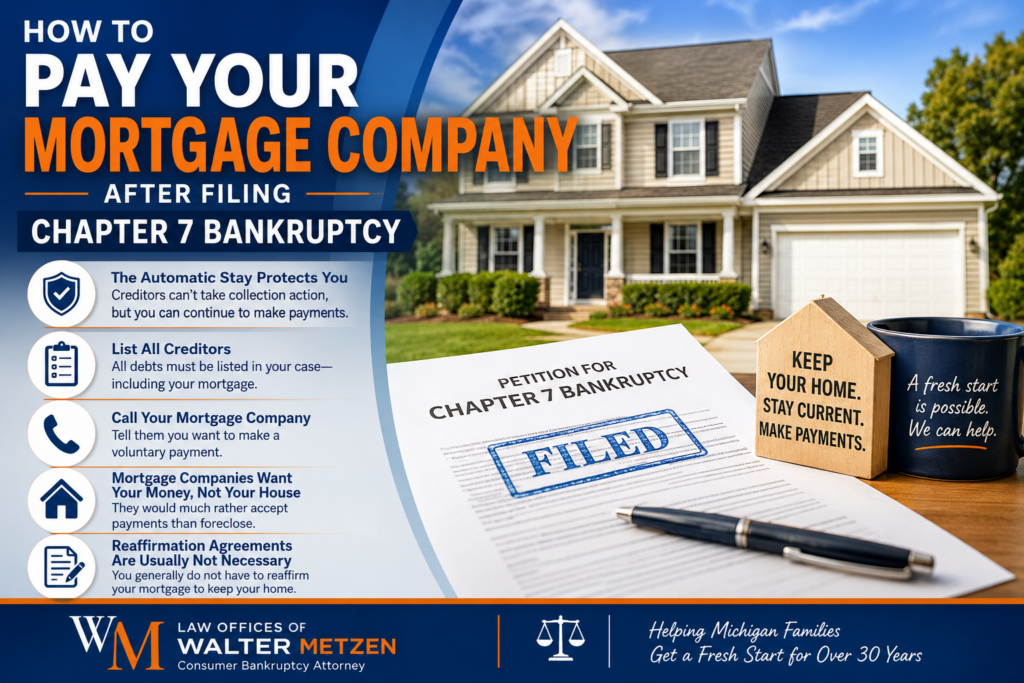
When your bankruptcy case is filed, the automatic stay goes into effect. The automatic stay is one of the most important protections provided by the bankruptcy laws.
Generally, the automatic stay prevents creditors from taking collection actions against you, including attempting to collect a debt, filing or continuing certain foreclosure actions, or taking other collection measures without permission from the Bankruptcy Court.
This sometimes creates confusion when it comes to paying your mortgage.
You may think, “If I am not allowed to pay my creditors, how am I supposed to pay my mortgage?”
The answer is that you can generally continue making your mortgage payments if you want to keep your home. You are making a voluntary payment on a debt that is secured by your house.
Your Mortgage Company May Stop Sending Statements
One of the frustrating things that sometimes happens after a Chapter 7 bankruptcy is that the mortgage company may stop sending you your normal monthly mortgage statements.
Some mortgage companies may also temporarily block your ability to make your payment through their online payment system.
This can be very confusing for a homeowner.
You may be sitting there thinking, “I have always paid my mortgage online, and now the website won’t let me make the payment. What am I supposed to do?”
Call the mortgage company.
Tell them that you have filed Chapter 7 bankruptcy, that you intend to keep your home, and that you want to make a voluntary mortgage payment.
Ask them how they want you to make the payment.
They may provide you with an address for mailing payments, give you instructions for making a payment by telephone, or explain how to regain access to the online payment system.
The important thing is not to simply stop making your mortgage payments because your statement has disappeared.
Mortgage Companies Generally Want Your Money, Not Your House
There is sometimes a misconception that a mortgage company is looking for an excuse to take your house after you file bankruptcy.
That generally isn’t how I view the situation.
Mortgage companies would much rather receive your monthly mortgage payment than foreclose on your house.
A foreclosure is expensive and time-consuming. If you are current on your mortgage and continue making your payments, there is generally no reason for the mortgage company to foreclose simply because you filed a Chapter 7 bankruptcy.
Remember, the mortgage company loaned you money to buy the house. The house is its collateral. The mortgage company wants you to make the payments that you agreed to make.
What Happens After the Bankruptcy Is Discharged?
In most cases, the mortgage statements will resume after your Chapter 7 bankruptcy case is discharged.
The mortgage company may also restore normal online access and payment procedures.
There can sometimes be delays or administrative problems, so you should continue to keep track of your payments and your mortgage balance.
If you are unsure how much you owe or where to send a payment, contact the mortgage company rather than simply skipping the payment.
What Is a Mortgage Reaffirmation Agreement?
Another question I frequently receive is whether a homeowner has to sign a reaffirmation agreement on the mortgage.
A reaffirmation agreement is an agreement between a debtor and a creditor in which the debtor agrees that a particular debt will continue to be personally enforceable after bankruptcy.
Reaffirmation agreements are common with certain automobile loans, but they are much less common with residential mortgages.
It is not common for a mortgage company to prepare and send a mortgage reaffirmation agreement to a Chapter 7 debtor. In many cases, a reaffirmation agreement is simply unnecessary.
As a bankruptcy attorney, I will rarely have a client reaffirm a mortgage.
Why?
Because the mortgage is already secured by your house. If you continue making the mortgage payments, you can generally keep the house. If you stop making the payments, the mortgage company has rights against the property under the mortgage and state foreclosure laws.
A reaffirmation agreement is therefore not normally necessary simply to allow you to remain in your home.
Do I Have to Reaffirm My Mortgage to Keep My House?
Generally, no.
This is one of the most important points for homeowners to understand.
You do not generally have to reaffirm your mortgage in order to keep your house.
You need to continue making the payments required under your mortgage and comply with the requirements of the mortgage and applicable law.
The bankruptcy discharge eliminates your personal liability for many types of debts, but it does not automatically eliminate a valid mortgage lien against your property.
That distinction is important.
Can the Mortgage Company Foreclose If I Am Current?
If you are current on your mortgage and continue making the required payments, the mortgage company cannot simply foreclose on your house because you filed Chapter 7 bankruptcy.
The bankruptcy filing itself does not give the mortgage company a reason to take your home.
The situation is different if you fall behind on your mortgage payments. A bankruptcy discharge does not eliminate the mortgage company’s lien against your home, and the mortgage company can generally pursue its rights against the property if you fail to make the required payments.
That is why, if you want to keep your house, you should continue making your mortgage payments on time.
My Advice to My Chapter 7 Clients
If you are filing Chapter 7 and intend to keep your home, don’t panic if your mortgage company stops sending you statements or temporarily prevents you from making an online payment.
Your mortgage was properly listed in your bankruptcy case because all creditors must be listed.
Instead of assuming that you don’t have to pay, call the mortgage company and tell them you want to make a voluntary mortgage payment.
Find out how they want you to make the payment and keep making your payments on time.
In most cases, the mortgage company will eventually resume sending statements after the bankruptcy is discharged.
The bankruptcy process can be confusing, particularly when you receive notices or see changes in the way your mortgage company handles your account. This is one of the reasons it is important to stay in contact with your bankruptcy attorney throughout the process.
I have been handling consumer bankruptcy cases for more than 30 years and have helped thousands of Michigan families deal with these issues. If you are considering Chapter 7 bankruptcy and are worried about what will happen to your home, this is something we can discuss before you file.
The goal of Chapter 7 is not necessarily to give up everything you own. For many homeowners, the goal is to eliminate their unsecured debt while continuing to make their mortgage payments and keep their home.